
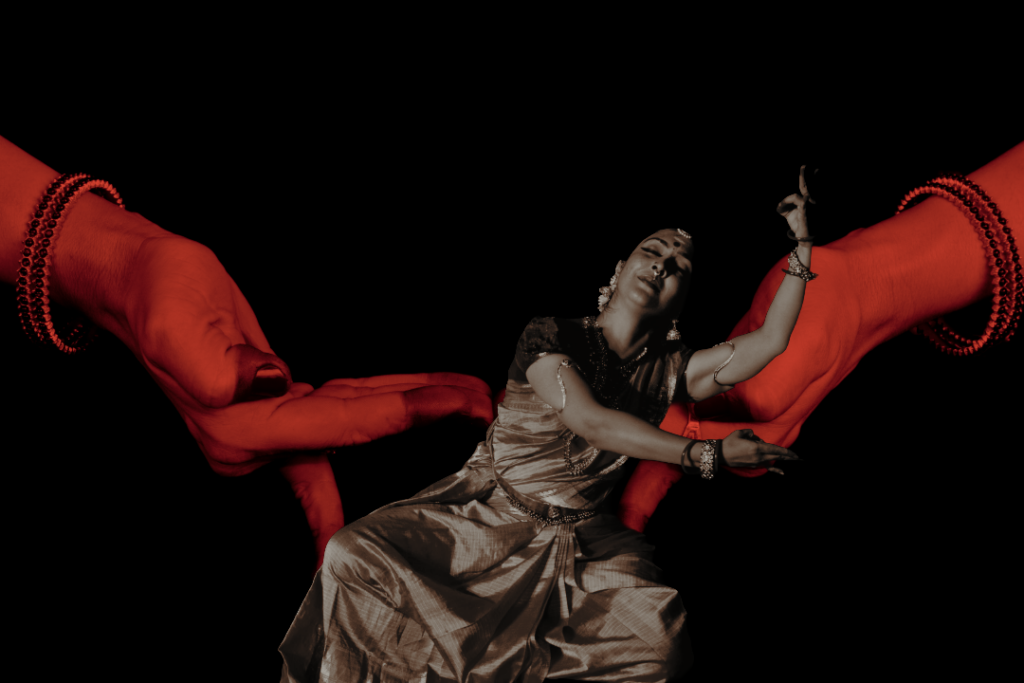
The lights in the auditorium go off. The stage is set. We enter, hands and feet synchronised, with each other, and with the music. When we are on stage, we engage in a conversation carried out entirely without words; one that is evocative and can express so much, without saying anything at all. This conversation unfolds on many levels. As dancers, we converse with ourselves, with each other as we dance, and with the audience, who eventually become part of the performance. I write this as a third generation Bharatanatyam dancer who has experienced many performances, both solo and group, where every movement holds meaning, every gesture is tailored to evoke emotion, and where every breath becomes a medium of translation. Before exploring how Bharatanatyam, as an art form, might encompass the task of translation, however, it is essential to situate it within its socio-political contexts.
Bharatanatyam, as a dance form that traverses the colonial and postcolonial frameworks, has had a long history, with varied ideologies, and power relations embedded in its artistic method, form, as well as practice. Once performed by hereditary dancers, (commonly called devadasis), it later became democratised within urban spaces, and was used as a cultural export for the Hinduised nation-state. Over time, Bharatanatyam become embedded in the cultural iconography of post-independent India, and functioned as a cultural export, asserting an Indian identity. Having come to symbolise “respectability”, this artform, legitimised today by upper-class and upper-caste ideologies, may offer women from these groups a space to affirm a sense of empowerment and agency, even as it continues to reproduce casteist, classist, and patriarchal notions of art, womanhood, and purity.
When a medium carries such complex, and loaded histories, how do we imagine the task of translation that it undertakes? What questions must artists and practitioners of this form confront, as they attempt to carry out conversations through it?
When we think of dance, the body becomes the primary medium of expression. Thus, the first level of translation that takes place within dance, is the transformation of emotion into bodily practice, This is perceived cognitively and somatically by the audience. Dance and its viewing involve, not just the historical, social, and political contexts of the artist and the performance space, but also the embodied, corporeal, relational, and temporal experiences that occur during the performance. Together, these elements shape the intersubjective “meaning” that flows from the dancer to the audience, making dance an infrastructure of cultural meaning-making.
Drawing on a neuropsychological, and phenomenological perspective towards dance performance and viewing, Warburton emphasises the role of mirror neurons in dance viewing, which enable the audience to cognitively “experience”, the emotions the dancer expresses. The study also shows that seasoned dancers and viewers display stronger mirror neuron activation, allowing them to “experience” the performance more deeply in their bodies than novice viewers. Experienced dancers often describe sensing the movements of other dancers, or predicting the direction of a choreography before they happen. Dance teachers and experts also state that an essential quality in a dancer is being able to connect to the choreography and make it their “own”, while translating the choreographic vision of the teacher.
Writing specifically about Bharatanatyam, Puri also argues that performers are often expected to translate emotions into carefully crafted sentiments that are methodically designed to evoke specific responses from the audience. As a result, dancers are expected to set their own understanding of the performance aside, as they “transform” into the assigned character. Additionally, the performance space itself is elevated to a consecrated realm, which in turn elevates the dancer’s position as the moral custodian of culture and tradition, as well.
In thinking about how dancing, dance learning, and dance, function as forms of translation, I also consider how cultural and political life shapes these experiences. Building on the idea of somatic empathy, where dancers might “know”, bodily, and anticipate the movements through experience; in the Indian context, it is essential to understand this from an intergenerational point of view, rooted in caste. Since Bharatanatyam itself is rooted in caste-based exclusions, this bodily sense of “knowing” is gatekept by caste. As a result, the dancer can converse only with certain audiences, who possess the cultural capital to access the performance.
Furthermore, because choreography is passed down through hierarchical and caste-based structures, the narratives considered legitimate within the “classical” form are often limited to what is seen as “pure” and “culturally appropriate.” This can be traced back to the history of Sanskritisation of Bharatanatyam, a process as Coorlawala describes as when dance forms designated as “ritual”, “folk,” are re-narrativised socially and artistically as “classical” and attain social and politico-artistic status. This process also involved the canonisation of the Natyashastra as the “authorised” text on classical dance, and the attribution of the origin of Bharatanatyam to Shiva, and Bharatmuni. This took the dance “from the temples to the stage of auditoriums; from the devadasi-community to the cultural elite; and from Tamil Nadu to the whole of India.”
Along with the changes to the form of Bharatanatyam, the content of the artform was also altered, and sanitised. Arundale, a key figure in this movement, argued that Bharatanatyam needed to be made “pure”by purging all references to sexuality, or sensuality. As a result, ‘Sringara’ (expressions of sexuality) was reinterpreted as Bhakti, with the deity becoming the object of this emotion. Compositions were altered to fit this sanitised ideology, and the body was policed to appear stiff and controlled.
The hinduisation of the content was visible in the portrayal of figureslike the ‘devi’, who, though “empowered”, still conformed to the brahminical and patriarchal ideals of womanhood and purity. Figures such as the ‘sakhi’, ‘nayika’, ‘nayak’ and the ‘deva’ were also introduced, reinforcing, through the artistic repertoire, heteronormative, brahminical, and hegemonic ideas of femininity and masculinity.
Despite its awe-inspiring potential, and impressive technique, Bharatanatyam remains in a contested position. As a practitioner, teacher, knowing its history raises many dilemmas, about using the language of dance as a tool for translation. One ongoing challenge is how to broaden the contents of the artform, so it can reach wider audiences and tell culturally relevant stories, while still staying true to the form itself. While the traditional repertoire of Bharatanatyam remains rooted in Hindu mythology, a reimagined version of the dance could help translate newer stories into movement, and therefore, potentially become a cultural instrument to communicate and share collective joy, grief, knowledge, and experience.
For dancers and teachers, it becomes essential to help students connect with their own embodied experiences, such that the biases in one’s choreographic visions, and performance practices, might be identified, and the hierarchical notion that dancers only need to make the choreographies their “own” without questioning their content and context might be modified. Additionally, tailoring the form to suit diverse bodies, instead of enforcing set ideals of “perfection”, can help us challenge students to reach their full potential. While Bharatanatyam remains a wonderful way to engage with diverse forms of cultural knowledge in India, it is essential to enable it to remain a dynamic form. The dynamism can translate new cultural experiences and realities, as well as make space for its own critiques within the form’s professional landscape.
Dance is, above all, an internal and external conversation. In Bharatanatyam, however, the roles of dancer and audience have long been treated as fixed, and the audience has been expected to be “appropriate and cultured” enough to understand the contents of the danceform. Discussions have centered around method, and technique, while the content tends to be taken for granted.. However, in entering a new era, facilitating the employing of Bharatanatyam for translating personal experiences, for students and performers from varied backgrounds, can allow for a true revival of the artform, to sustain meaningful conversations around embodied experiences. By questioning the power dynamics of earlier translations of meaning into movement, we can reimagine Bharatanatyam as a true conversational space, bridging gaps across language, background, and identity.
.
.
.
.
.
References:
- Bansal, A. (2020). Past, Present, and Future of Women in Bharatanatyam. SSRN Electronic Journal. https://doi.org/10.2139/ssrn.3683980
- Coorlawala, U. A. (2004). The Sanskritized Body. Dance Research Journal, 36(2), 50. https://doi.org/10.2307/20444591
- Pillai, S. (2002). Rethinking Global Indian Dance through Local Eyes: The Contemporary Bharatanatyam Scene in Chennai. Dance Research Journal, 34(2), 14. https://doi.org/10.2307/1478457
- Puri, R. (2004) Bharatanatyam Performed: A Typical Recital, Visual Anthropology: Published in cooperation with the Commission on Visual Anthropology, 17:1, 45-68, DOI: 10.1080/08949460490274022
- Puri, S. S. (2011). Divine Women: On young female middle class Bharatanatyam dancers in Delhi. In S. Prlenda, & R. Jambrešić Kirin (Eds.), Spiritual Practices and Economic Realities: Feminist Challenges (pp. 75-94). Ethnology and Folklore Research & Centre for Women Studies. Feminisms in a Transnational Perspective Vol. 3 http://www.hr.boell.org/downloads/dubrovnik-prijelom_%282%29.pdf
- Puri, S. S. (2015). Dancing Through Laws: A History of Legal and Moral Regulation of Temple Dance in India. NAVEIÑ REET: Nordic Journal of Law and Social Research, 6, 131–148. https://doi.org/10.7146/nnjlsr.v0i6.111057
- Warburton, E. C. (2011). Of Meanings and Movements: Re-Languaging Embodiment in Dance Phenomenology and Cognition. Dance Research Journal, 43(2), 65–84. https://doi.org/10.1017/S0149767711000064