
I spoke to Rejaz M. Sydeek for the first time a year after Isreal’s ongoing genocide in Gaza began. Rejaz, a 27-year-old activist and independent journalist from Kerala, India, had initiated Friends of Palestine–Kerala after the war in Gaza intensified. The interview was part of my exploration into individuals who were actively resisting the genocide through advocacy and campaigning.
On May 14, 2025, Rejaz was arrested for criticizing the Indian government’s attack on Pakistan under ‘Operation Sindoor’. He was accused of possessing ‘incriminating’ literature, including books on Marxism, caste-based violence in India, and Kashmir. He has been charged under the stringent Unlawful Activities (Prevention) Act (UAPA).
Rejaz knew that one day he might be implicated under false charges and accused of being a Maoist. The chargesheet against him also lists his group, Friends of Palestine–Kerala.
This is not an isolated case. Governments around the world are attacking individuals like Rejaz for speaking out against human rights violations. These individuals are labeled as terrorists, terror sympathizers, organizers, or funders. Perhaps, now, even those labels are unnecessary, being an activist has become a dangerous label in itself. Even a comedian’s joke is a serious offence, laughing in the corner of investigation rooms.
So the question—what keeps the resistance alive? emerged from the questioning of these labels, and the ongoing demonisation of people who resist.
F’s Acts of Resistance
F, a social worker from Australia, hung a Palestinian flag on the wall behind her, clearly visible during every Zoom call. This act of resistance aimed to make her workplace management uncomfortable, as she was forbidden from speaking about Palestine. She spoke of the growing demonstrations opposing the Australian government’s weapons deal with Israel. On September 12, 2024, protestors in Melbourne clashed with police while opposing the defense expo.
“The Victorian state government put aside 15 million Australian dollars to fund police to brutalise protestors and gave them extra power citing anti-terror activity,” said F.
Throughout her life, F has participated in marches and rallies, but the Palestinian cause has now strengthened her belief in the interconnectedness of liberation. F‘s parents lived through the Vietnam War, and she has witnessed how Western media often portrays East Asian women as submissive.
“My liberation is connected to other people’s liberation. It’s all connected. So, liberating myself from these ideas and norms has been a pertinent part of this whole experience”, she said.
The imposed norms have long defined who is seen as inherently good or bad based on their identity and origin.
“Everyone-every child, every person, has a chance to live out their lives free from tyranny so they can be who they want to be. I haven’t had the opportunity to be with my nieces and nephews. I think of this as an extension of being an auntie who is struggling for a world where children, who are their age, younger of all ages can actually grow up and live, like, in dignity. And so, that’s basically, my hope”, she said while delving into the question of what is important for her.
The state might label F as an activist and try to box her into a single narrative. Her workplace might expel her for using Palestinian symbols. However, the deeper story of her family’s past and her hopes about the children in the world, may never be told.
The ongoing genocide that is happening miles away might be shaping your identity and giving new meaning to your life as well. Reflecting on F’s journey, how have you been resisting since October 7, 2023?
What M and Abdulla value in life?
The act of resistance does not happen in a vacuum. Going out in the morning to demonstrate against the killing of children in Gaza does not only mean that you are against the Israeli Government’s action or your own government’s complicity in it. All those people standing together in the march or sailing seas have ascribed their own unique meaning to these actions.
M, a therapist based in Australia has attended many rallies around supporting and amplifying the Palestinian cause. She has tried to understand her role in the struggle during this time. She holds the belief of justice close to her heart, and witnessing the violence taking place in Gaza has violated that belief system she lives by.
“When I think about justice, it’s like you can see the wrongs and sometimes you can feel the wrong and that pain physically in your body. Sometimes I don’t have the words to explain what justice looks like but I know what it would feel like – it feels like the opposite of what the wrongs or the harm feels like…What it feels like to hear the stories of others that have experienced injustice; justice would look like feeling the opposite of that”, she said while trying to give voice to her idea of justice.
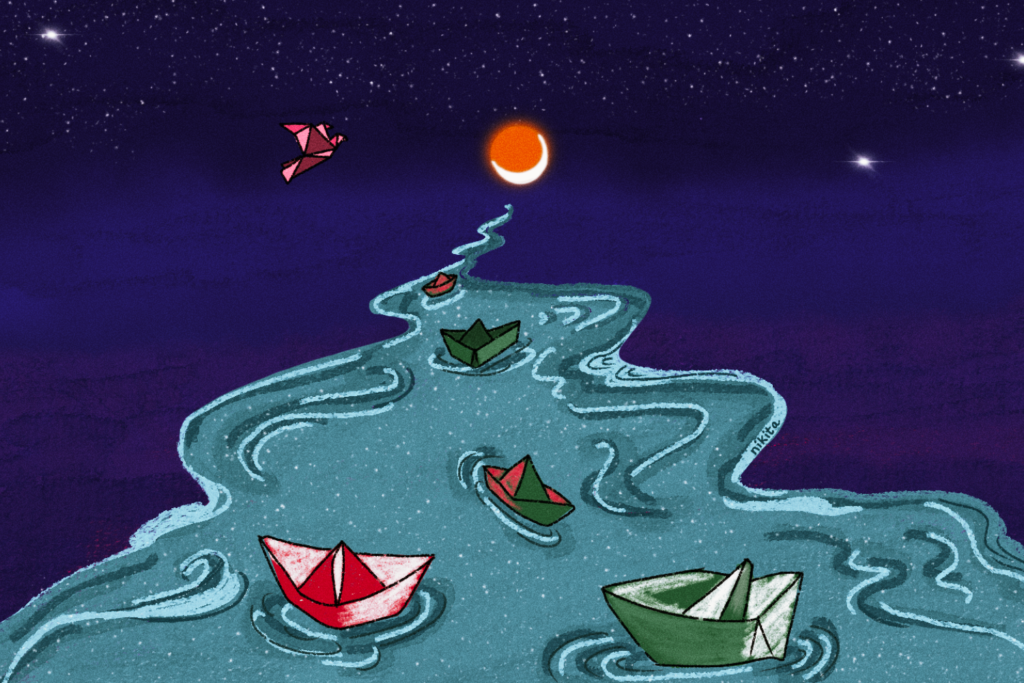
M struggled to explain this value of justice but tried to create an image for herself. “It would be like when you are sitting at a beach and you can see the sun setting against the ocean and it’s that really beautiful shade of orange – there’s something about justice being represented by that image of the sunset…It represents hope as well as possibility”.
This idea of justice is unique to M. Others would have their own idea of what their values look like in words, images or through songs.
Heads up, these values and belief systems might not matter to the system. For systemic institutions, taking a stand for Gaza would mean taking a stand for injustice happening in our own backyard. They feel threatened by such actions and use their power to discipline individuals.
For Abdulla, participating in a demonstration cost him his job. Abdulla worked as an imam in a local mosque in Kerala. After officials questioned him about his activities, the mosque committee dismissed him. His resolve is firm because he cares about humanity and the oppressed. He never intended to incite violence.
“If we don’t raise our voices to speak out for people facing genocide in the modern world, then we are the lowest beings on the face of the earth. We must tell political movements and business lobbies that humanity is greater than racial and national boundaries,” he said.
Abdulla left his hometown due to the threats he faced. He may never be in a position to defend the belief system that inspired his protest. To the system, he is merely a ‘violence instigator’.
For M and Abdulla, belief in justice and humanity is important. Maybe take a moment to reflect on, what do your acts of resistance tell you about what matters to you?
What inspires Rejaz?
It’s not only individuals who are moved, movements and organizations also draw inspiration to act. The Boycott, Divestment, and Sanctions (BDS) movement is inspired by historical struggles against racism and colonialism, in South Africa, United States of America and India. BDS efforts led American businesses like Starbucks to lose around $15.1 million due to their complicity in human rights violations committed by Israel.
Many have felt inspired by celebrities and brands who choose to use their platforms to shift the narrative on Gaza. Morally grounded businesses like Wind Villa Kyoto, a small hotel, made more waves than Airbnb.
The source of inspiration that shapes our values and belief system can be drawn from anything, from historical events to life around and beyond us.
Rejaz M. Sydeek draws deep inspiration from indigenous communities fighting to protect their resources. He has written about caste-based discrimination and human rights violations in India.
Rejaz comes from a Muslim family but identifies as an atheist. Ironically, his name alone prompts many to label him a ‘Jihadist’ or ‘Islamist’, labels he dismisses with laughter.
“My Muslim friends tell me, ‘You are practicing Islam in your own way by helping others.’ I don’t know. What matters to me is my actions and what I do for others. People can tag me anything,” he said.
When I had asked him during the interview to draw any image that came to his mind during his campaigning for Palestine, he immediately drew a picture of a policeman. This image was a reminder of the constant surveillance he was made to face.
“My mother fought against injustice in her own family. When her brother married a woman from a marginalized caste, the family disowned them. She stood by them and defended their choice. Her belief in justice and humanity led her to take that stand and she has influenced me,” he shared when reflecting on those who inspire him.
Rejaz has seen the fear in his mother’s eyes during police inquiries. She often doubted whether he could withstand those in power who are against his politics. But he reminded her of her own act of courage, how she stood for her brother when he didn’t find any refuge.
Again, for the system he is merely a ‘Maoist’, a tag he might not even reject if his definition of ‘Maoist’ is someone fighting for land and rights. In January, Free Rejaz, an online movement, had posted about the 24-hour hunger strike by Rejaz in prison against US imperialism and threats to South American nations.
Ever Thriving Resistance
I had an answer to ‘What keeps the resistance alive?’.
I would love to be friends with F and those who are rejected by the system and its institutions for their activism.
I would love to sit with M and watch the sunset over the horizon. The orange hue would always remind me of justice. I would like to picture a bird flying high above against that orange backdrop in the sky. The idea of freedom and justice belong to everybody in this world.
I would like Abdulla to have a life in his own country where ‘Red bananas ripen. Jackfruits burst’ as Arundhati Roy writes in God of Small Things. May his love for humanity always win.
I want Rejaz to be free, and surrounded by his mother’s love and his favourite books. It’s not the ‘incriminating reading material’ but his mother’s courage that influences him to move in this world.
I’m grateful for the conversations I had with these individuals. One conversation led to more curiosity to seek out people for the interview. I often wonder: what possibilities would emerge if we share their stories of solidarity and resistance for Gaza? What would it mean for the world to witness the hearts of these people? What might happen if we stitch these stories and more stories together on a world map to create constellations?
……………
.
.
.
artwork by nikita