
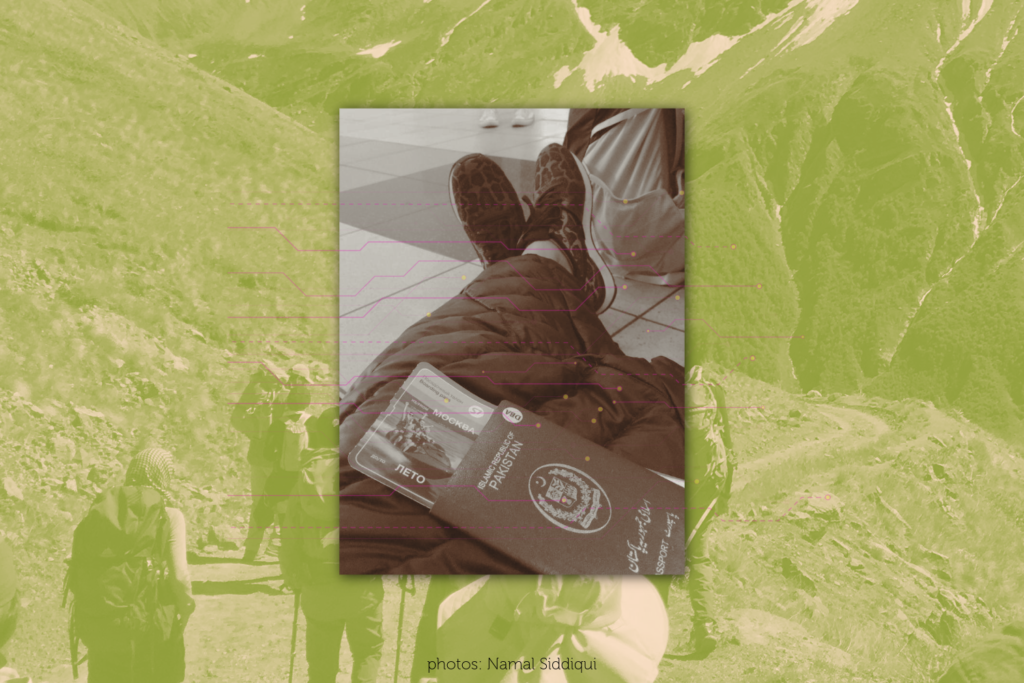
The body is not national,
it passes easily into dreams
mountain ranges, rivers and oceans,
routes traced by swallows.
I want
the clouds’ passport
valid for travel to all countries and back.
— Pass, Passport, Passaporto, etc., Pia Tafdrup (translated from Danish by David McDuff)
Hold your breath
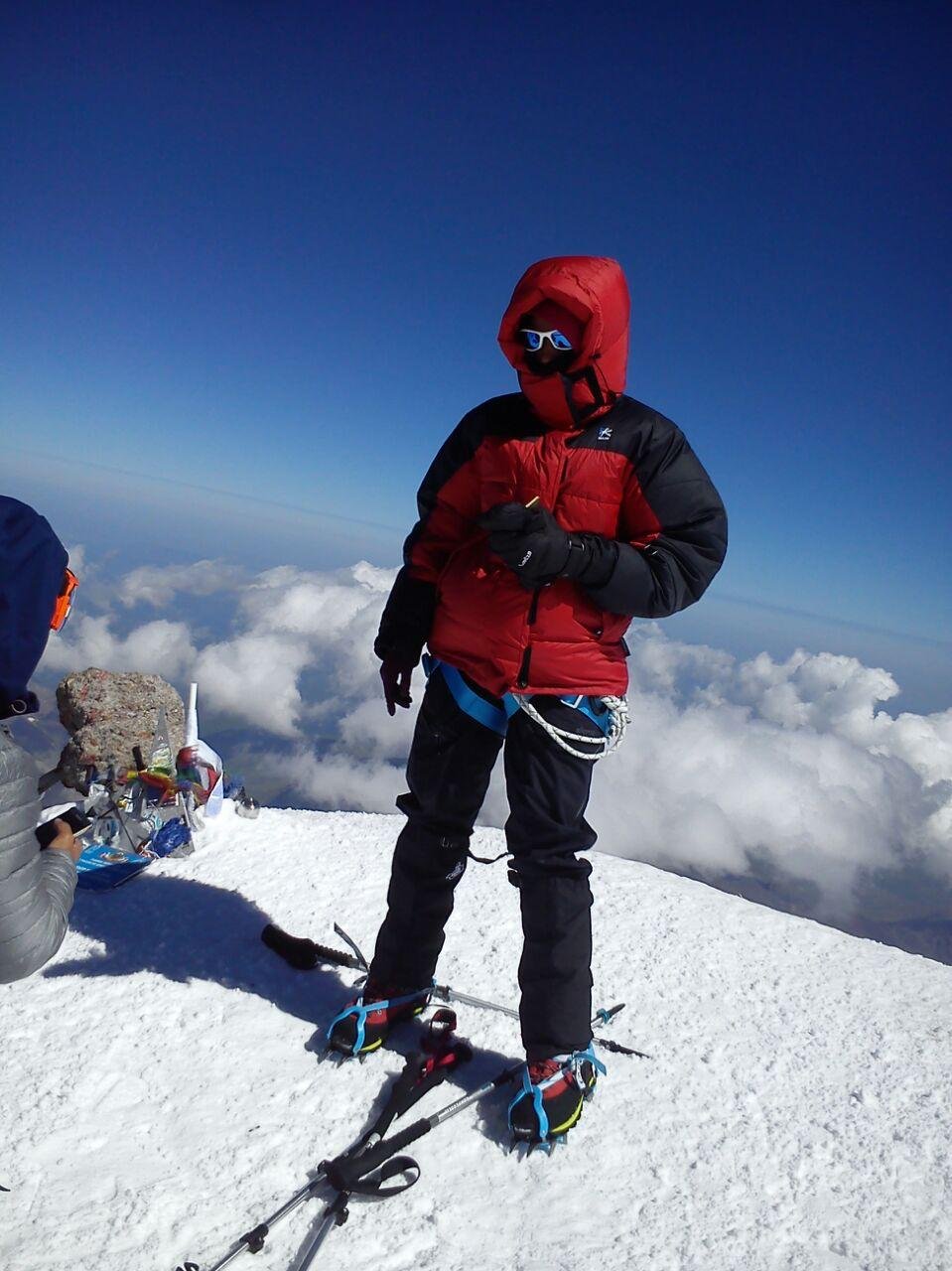
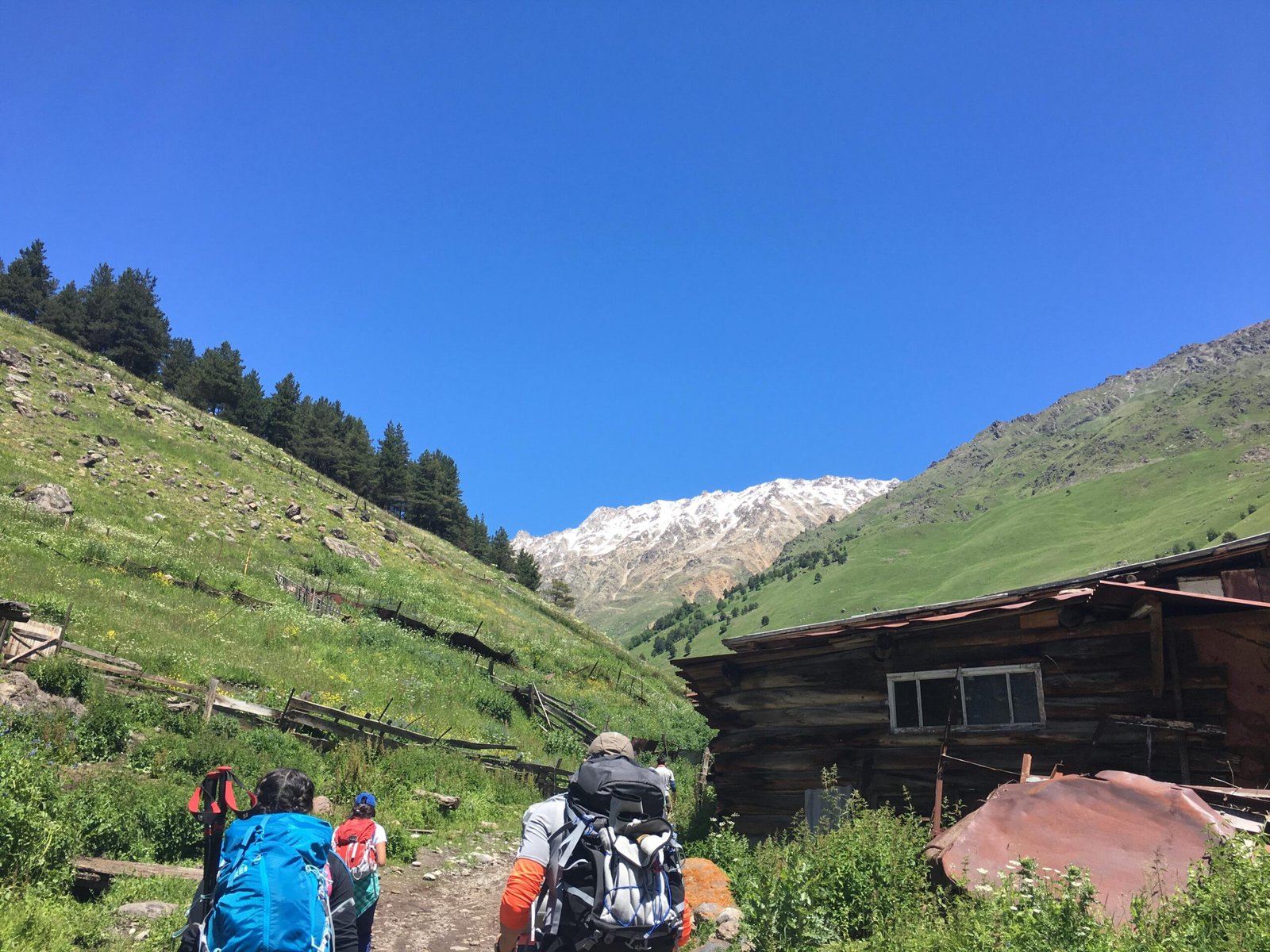
In 2016, I decided to head off to the Caucasus’ in Russia to climb. It was my first trip to a mountain, and third adult-solo trip to another country. A desert girl making her way to icy mountains surrounded with lush and radiant flora she had never seen before. Life in 4K. My mountaineering gear was all packed and I had been wearing my new hiking boots everywhere for two weeks to break them in. Yet, I wasn’t even sure if I was going to make it to Russia, if I would be permitted. I was half excited and hopeful, and half ridden with anxiety. I am a UAE-born-and-bred Pakistani and to be able to travel to Russia I had to visit the Russian consulate at least four to six weeks prior, with extensive documents, proof that I had a climbing trip planned, that I had an invitation from a Russian climbing company, enough money to spend in my bank account, and ‘enough’ proof of permanency in my resident country to have the need to return. A proof of existence and a proof of return. I received my visa the evening before I had to travel. I was on the edge of Mount Stress-and-Anxiety and I managed to not fall off. Eleven days later on a beautiful July morning after toiling on ice, first in the LED-lit shadows of our head torches, and then the light that appears after dawn from the horizon of hope, I made it to the top of the dormant double-peaked majestic Mount Elbrus, the highest mountain of Europe.
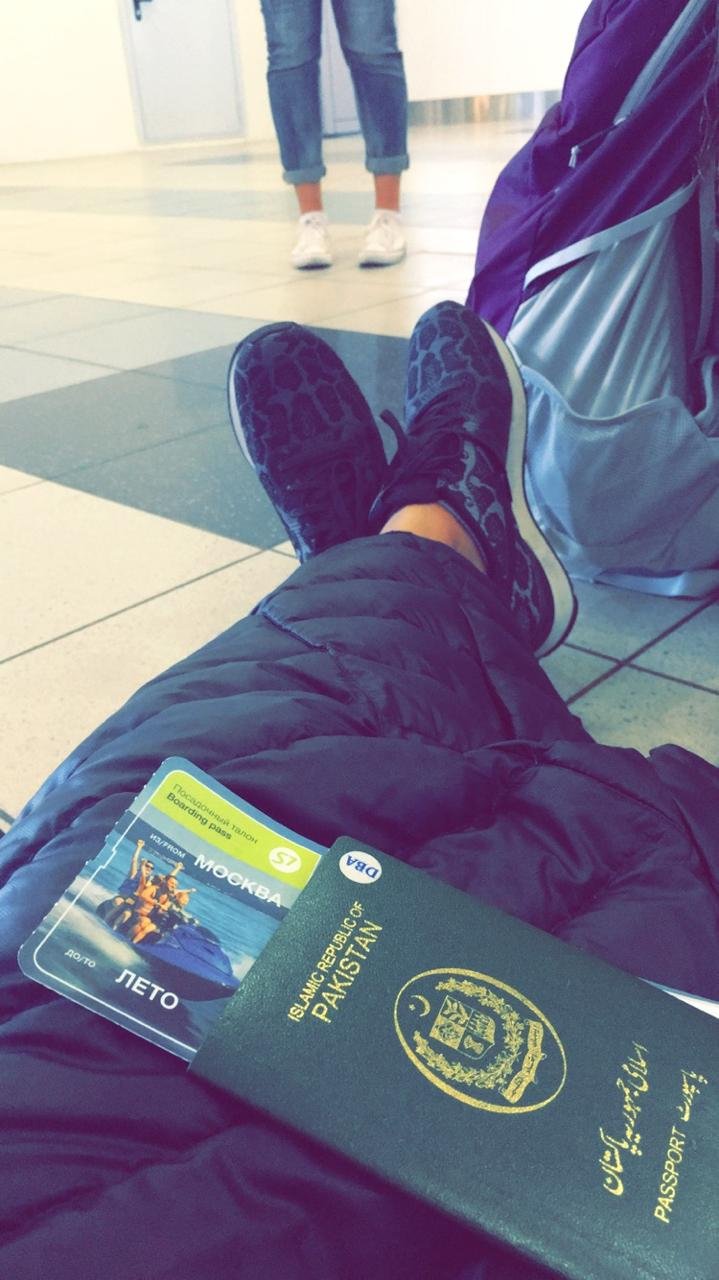
This achievement of adventure has never been a simple task. Obtaining a visa to visit another country on a Pakistani passport can be a mission. You can’t just leave as and when you will. You must plan the unplanned. You must curate the spontaneous, even. Someone once called me calculated; that even though it seems I live a free-spirited life, I have thought of everything beforehand. Language is important in this phenomenon we are unravelling. As if planning is undesirable in this context. As if I haven’t dreamed like others of taking flight among clouds, arriving in new places, and witnessing the world. As if simply dreaming with the ability to instantly go is when dreaming is right. But who decided that my dreams should come with a stack of documentation and proof of my intention to be a good citizen of the world. That I should always return to where I came from. As if some humans on earth have the right to move freely never looking back, but some must always return. Always come back to reality, not forge life possibilities elsewhere. As someone raised in the diaspora with a degree of means, I have had the privilege of travel possibilities that I know so many do not have, even if those possibilities are ticketed based on identity. That my identity is not the stuff I dream of and want, but the colour and content of my passport. As if my existence is or could be a crime.
The migrant soul’s ticketed freedom
Passports were only standardised after World War I when with the influx of refugees, countries began to formalise movement. Now a necessary travel document that at a basic level identifies your origins, your religion and your age. Before that and over many hundreds of years, people often used travel passes or letters of recommendation issued by a senior authority, or religious leader, who offered their reassurance about the intention of an individual to pass through regions for trade or pilgrimage.
Before that and over thousands of years, human beings moved over land and across oceans, without asking. Movement was long term and often one-way. The migrant soul moved through territories and time, existing in different parts of the world. For our nomadic ancestors, peregrination was a natural way of living.
They walked the land crossing plains, deserts, mountains, rivers and valleys, crossing regions a long time before they were defined as continents, countries and nations. There was no obligation on us, no permission required for the earth was free land, not belonging to one person, one nation, one group of people. We were nomads first. Through instinct and learning we navigated through, and perched on lands that suited us best by season. We journeyed not to settle on a piece of land, not because we needed land, but because of what the land offered to us at the moment. Respectfully, we moved on when it couldn’t. Respectfully, the land refreshed and revived so it could lay bare its offerings again. As indigenous people today do, humans have followed the natural systems of the cosmos. Over time we became sedentary, yet movement at a migrational level continued. Co-existing is a concept humans have known far too well, especially across Asian and African lands.
But something went wrong. What began as curiosity and trade tours from across the oceans, became a game of greed and power. Over the last five centuries European countries leveled an unparalleled scale of subjugation across Asia and Africa. All under the pretext of being a superior race, with a superior religion. The history we read today is often told from a white gaze anchored on the same notions of superiority, the oriental gaze as Edward Said termed it. During this time the earth witnessed conquests of lands, enslavement of indigenous people and the mission to civilise what is savage. What is savage? That which doesn’t speak a white man’s language, that which doesn’t follow the same etiquette and living standard?
Rapid nationalisation and independence of colonised countries post World War II rewrote borders, but religious, racial and linguistic divides had long been sowed. Terminologies like developed, developing and under-developed countries or first and third world countries continue to create imagined concepts of civilisation and savagery. The colonised post-independence is now slave to colonies of technology and bureaucracy, systems and processes.
The coloniser continues to orchestrate our lives with a sense of superior management. Border controls employ armies, technology, laws and violence to keep people out, or in. A hierarchy of passport quality is another form of colonial violence. Who decides what constitutes a good passport? Passport holders from the Global South face more border scrutiny, expense and wait-time when obtaining visas to visit or move to other parts of the world whereas, any Western passport will have ease of access to most countries, often with an easy visa-on-arrival process. It is population management and control at a global level. Movement and life orchestrated by the powers that are.
The precarity of travel on a Pakistani passport is more than the lack of spontaneity or possibility… It is to live carefully, calculatively, and by measure. To feel limited by the way we can move and because of the burden and mundane, monotonous task of filling out proof documents we view our life as a report, a proof, a statement of proof. A directory of things we do under watch. Always feeling like we are being monitored which rings true when we cross borders. This is how people of land are made to disconnect from it. By embroiling the once-colonised, in meaningless accounts of life. Less chances of dreaming. More of the accounting of life through tedious paperwork and no, it’s not poetry.
Travel is a political act
My Pakistani Instagram friend whom I’ve never met, Danial Shah, while pursuing a PhD in Brussels in the year 2024, decided to make his journey home by land. As a child living in Quetta, he often found his city a hub of European ‘hippies’. It was indeed known historically as the gateway to Europe and the route leading to it as the London Road. ‘The Hippie Trail’ that began in different parts of Europe all the way to the Far East was a counterculture phenomenon that emerged between the 1950s and 70s. Danial decided to start his journey from London too, a childhood curiosity coming to life. How was it to travel by land in earlier days? This was certainly to come with many offsets for air travel makes things simpler with the airport as a single checkpoint. Land travel however is a longer tedious process where border laws can seem less assimilated. For Danial, land travel offered space and time to see what’s beyond his own lands. People and temperaments. Local customs and practices. So in a quest to experience traveling as a Pakistani Muslim man and the challenges it would certainly summon, Danial began the journey to his birthplace, crossing borders using buses, trains, taxis and ferries from ‘the coloniser to the colonised.’
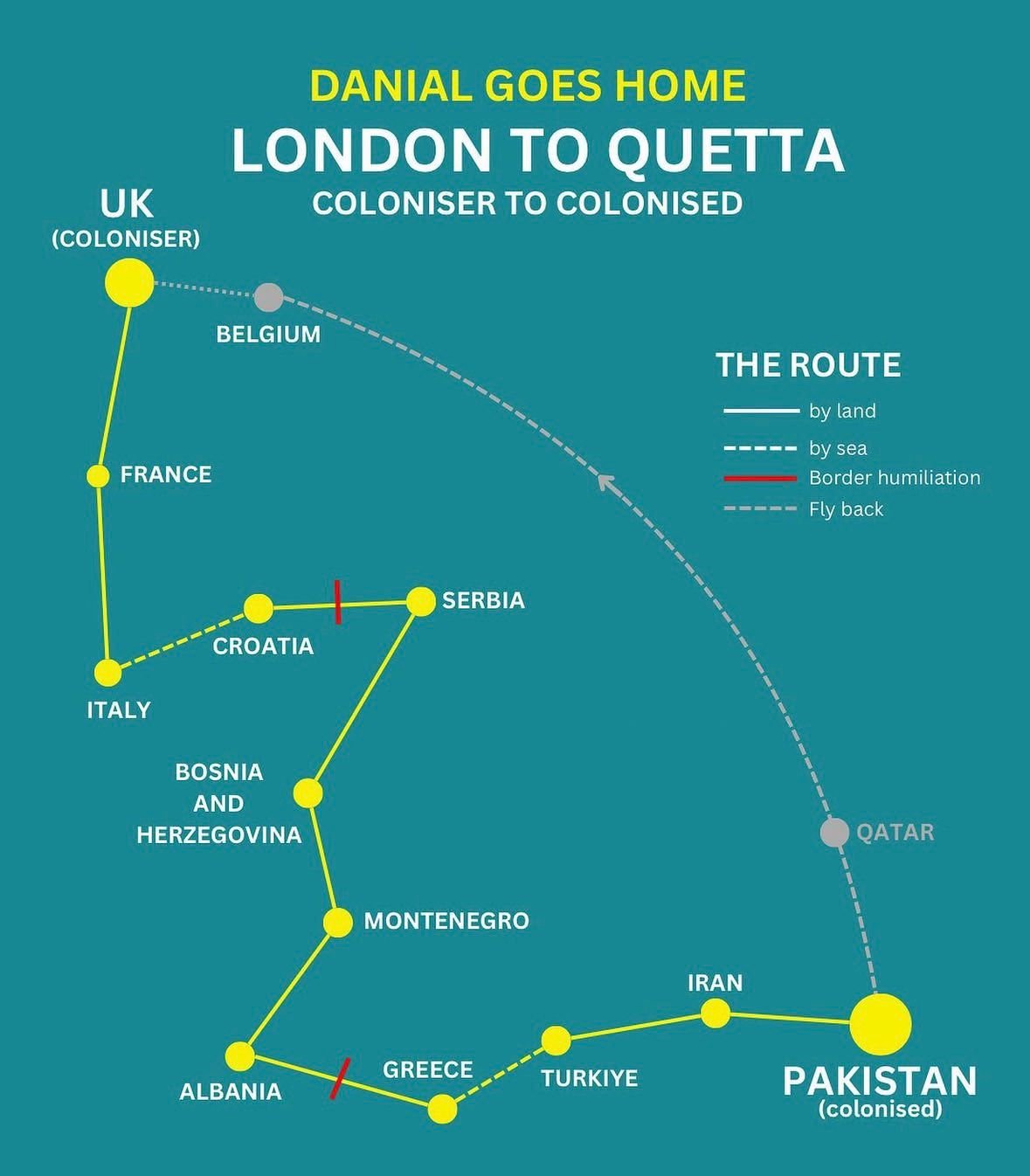
Danial shared this enduring journey on his instagram account. The list of documents to apply are endless along with the waiting time. Each authority needs ample proof that after your visit, you’ll leave the coloniser’s land. This process after occupying the sub-continent for over 200 years and depleting it of its resources while leaving its economy to shambles is quite humiliating. Through his journey, particularly in the UK, Danial points out the outright absurdness of typical British tropes but to someone who comes from a colonised land those tropes seem obvious. In London, Danial comes across a touristy postcard that offers visuals and statements that depict Britishness with the phrase, ‘You can tell I’m British because… I don’t speak a foreign language.’ To which Danial’s response is, “Because you imposed your language on the colonies and forced them to speak English and then charge 254 Euros for IELTS to prove their proficiency”. The empire today is a capitalist machine. There is a cost everywhere. At the time of writing, nothing can be truer than the display of current global geo-politics performed by the Global North on the Global South.
In his book Magic Bus, Rory Maclean sets out on the path of the famous hippie trail where he explores ‘the first movement of people in history travelling to be colonised rather than to colonise’. The exotic East is a place where the intrepid travel to, a submission for many to search for themselves and to travel cheaper. However, there is a significant difference for a traveller crossing world borders with a Western and/or European passport as opposed to a person from the Global South. A quick look at the Global Passport Index Charts provides confirmation to passport rankings and their limitations. The brown and black traveller is already regarded as a red flag. Why are they on the road? What is their intention? The body is the border. While crossing the Croatia-Serbia border on a bus, Danial was the only Pakistani amongst a sea of Caucasian travellers. Tall, brown and bearded he was quickly singled out for interrogation in spite of him having all the required documentation. “You are not allowed to feel like a traveller,” says Danial. Border crossings are designed to be more like criminal-check crossings. In that, the body becomes the border.
It took Danial 30 days to travel from London to Greece. The journey through Europe felt industrial and hostile. More than anything, hostile. Danial found it exhausting to connect with other tourists and travellers. “They travel with no plans and book last minute”. The hippie trail today continues to be aloof to the once-colonised. Western passport holders often need not worry about visa validities and grace periods whereas Danial’s visa had an expiry date. He couldn’t afford to leave aside forward-thinking at the risk of paying fines or becoming undocumented. The final leg of his journey included another 30 days between Turkey and Iran. After all the interrogation in Europe, moving into Iran, Danial felt a familiar peace descend upon him. Iran and Quetta share borders, and Danial is no stranger to Iranian cinema and retail products like candies and drinks found in Quetta’s supermarkets. It was an emotional union to a country Danial had never been to but sits in contiguity to his city.
In Iran, Danial sighs in relief with a sense of welcome familiarity. A smile, a handshake, a conversation, a courtyard, a hearth came often as an act of generosity to timeworn travellers. Perhaps, why Danial felt freer and at home. As Danial moved on from Europe to Asia, he became witness to the transformation in texture, warmth and culture of the landscape. Quetta is multi-lingual. People speak Uzbek, Dari, Pashto among other languages which morph across borders. They merge and marry to become different versions of themselves, a reminder that the land came first and language is simply a human attempt to connect. Language is an attempt to do what humans can’t do as land — be one, be whole, be connected.
One can also see what border and national loyalties can do to a group of people. Danial saw that families were in better economic conditions as opposed to its divorced half. “The lively presence of youth is a sign of progress”, Danial says, and this is evident there. As I write this, there is war unleashed upon Iran by the US and Israel, and the world’s politics is taking a tumultuous turn drenched in fascism and further border controls. A sense of panic prevails as we try to live our lives. Every act is political.
Who are we in this complicated world? – Rumi
In Russia, somewhere in the mountains, I met a Chinese solo-traveller who went by the title ‘DontUTurn’. He had a large customised van which was his home for four years. It had everything he needed. He had some savings, but also worked on and off on the road while his friends would sometimes join him in different countries. After traveling to over 150 countries in his van, he was finally returning to China.
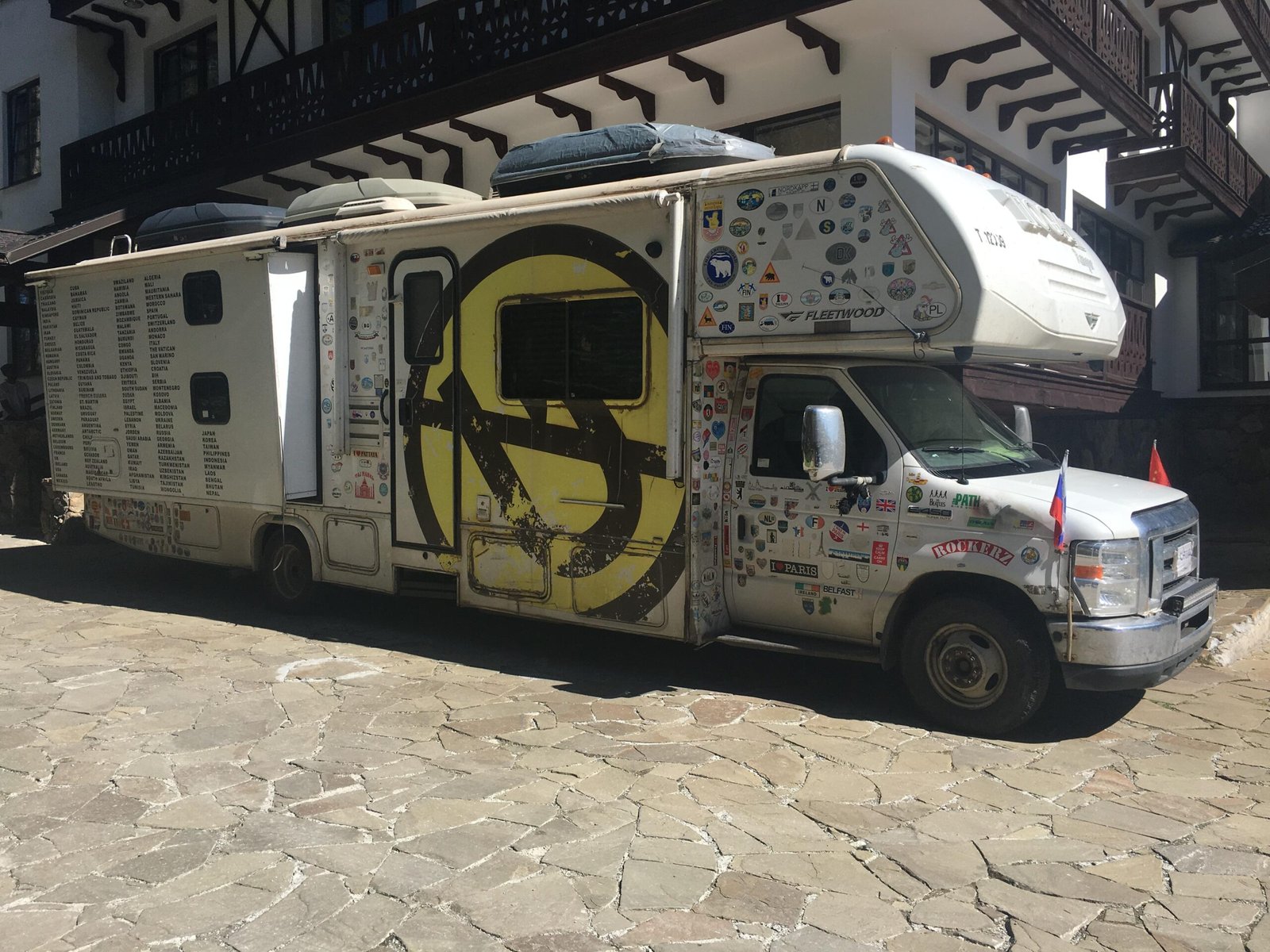
I cannot find him on the Internet anymore and in hindsight, I did not understand the journey I was going to take with the mountains, and all the visa runs I needed to make. I would have asked him how it was to travel across lands as an Asian person. What did he want from his travels? Like Danial, roam the trails and tracks of the earth and know its peoples. Like me, climb mountains on stranger lands. Or was there no goal because the journey itself becomes a way of life.
In many ways, I have had the privilege of living with experience. I began to travel alone later in life, at 26. While in the UAE my parents always travelled back to Pakistan, saving and savouring every holiday for the homeland, their parents, and the larger family. The extensive documentation preparation was an independent education that was first a matter of obedience, then agitation, and then over the years, a reason to understand where I come from and the histories attached to it. It was a layered enquiry into identity, not just mine, but those like me and vice versa. My task is to ask questions and not believe everything at face value. If not entirely, then partly certainly, it is the reason I read and write poetry and non-fiction.
I began writing this essay a year ago with Danial’s story. The story lingered on my mind until the narrative began to develop. Danial’s perspective within and outside of Pakistan’s borders, and mine from the Pakistani diaspora in the Arab world. What drove me to a conclusion was when my spirited friend, a Thai author, had her invitation-supported visa application rejected for an Indian literary festival, whereas her Australian partner who was simply accompanying her, received his. It made me realise how relevant and relatable this conversation continues to be for the Global South, especially now. I don’t have an answer but I can ask questions. Questions are free to travel.
.
.
.
.
.