
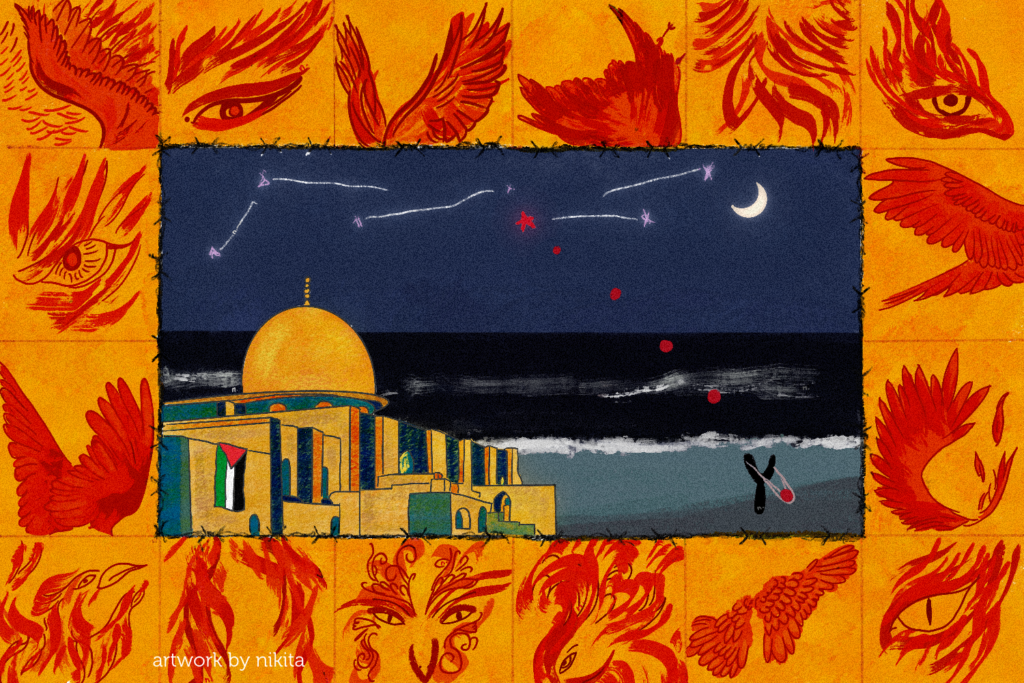
The myth of the phoenix lives in the human imagination as an undying bird that burns only to rise reborn from its ashes. Living under siege and fire in Gaza, the air between myth and reality thins.
Born from ancient Egyptian mythology as a bird that worships the sun, the phoenix is a symbol of life and human desires for immortality and strength. And above all, a belief that endings are not final and that we can return in new forms. Often, myth feels like an attempt to beautify what reality cannot easily comprehend. Gaza is no longer merely a metaphor for such an idea; it has become a living test of it, as if forcing myth itself to leave imagination and enter the ground, where nothing is purely symbolic and nothing is detached from real pain.
Gaza does not experience a complete moment of burning or a complete moment of rebirth. Instead, it lives in a continuous state of re-formation, where nothing truly ends and nothing begins anew. Every moment here carries the trace of what came before it and opens the door to what comes after, as if time has lost its linear path and become a circle of exhausting repetition and renewed meaning.
In the tale, the phoenix chooses its burning in order to be reborn, while we have made no such symbolic choice. My reality today is not mythological; it is the tent I have lived in for three years, since I was first displaced and saw my home once a place of warmth and safety turn into rubble.
This occupation has imposed a merciless reality upon me; it stole our homes, but it did not stop there. I have lost two of my cousins, and I have witnessed my brother be injured twice, in a body that desperately tries to gather the remains of what is left of our family. I do not live a voluntary “re-formation”; rather, I live a daily state of survival amidst endless ruins, where I try to draw my strength from the fragments of memories of the home that was destroyed, from the resilience of my brother who survived twice, and from the faces of those we have lost who have become the stars of my own constellation.
Life here is a renewed act of daily challenge, as we are left to continuously reshape ourselves under pressure.
And what are we to do with the rage? Like the myth, our rage is also undying, and like the bird, it is free to travel the world. And miraculously, somewhere, it reaches love. While our bodies are confined, over the last three years of genocide, our voices have found ways to escape and reach more people than I could ever imagine. I have organized with people in different countries on writing workshops, fundraising, and publishing essays and independent booklets that document our personal and social narratives. In this path, I have found solace in the fact that I am not alone, even when I am.
I wonder about the countless ways in which the phoenix has been cited in stories across languages. What would that map look like? And if we could map how far the stories of my people in Gaza have reached, what would that map of solidarity look like? Unlike the phoenix, this “constellation,” at least, does not have to burn and be reborn to live; it simply lives, undying.
It is as if we are distant stars held together by the insistence on being seen and heard, refusing to be erased. Our constellation is not born from proximity, but from the determination to remain human. I write because the silence is far more unbearable, and in writing, I have found other stars. I scream and rage across distances I cannot measure because it is the only path left, and I have found others who scream love.
All of us are stars reaching for each other, writing, screaming, and perhaps somewhere, someone is catching this light.
.
artwork by nikita | @itsjust._.nikita
.
.
.