
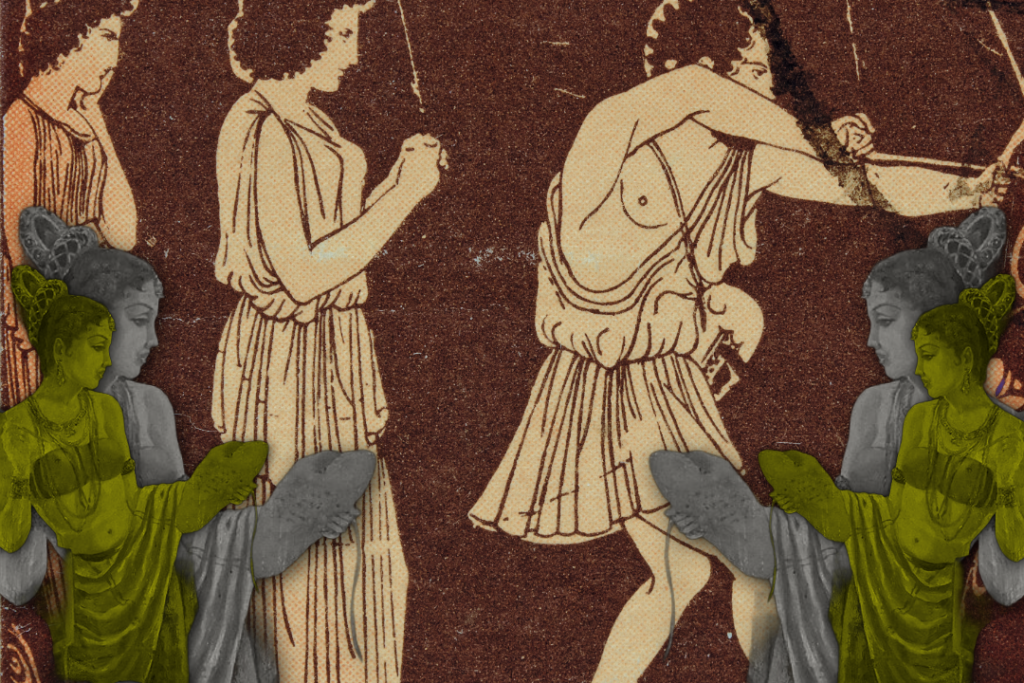
Who tells your story decides how your story is told.
A tale mutates each time it changes custodians. In this process of shape-shifting, a story is pried open, reshaped, rearranged, rewritten to make it palatable to the present. The inconvenient gets trimmed away. The anger gets softened. The pain gets poeticized. The political gets cauterized.
Translation is seldom innocent. It can mean choosing, omitting, converting, even possessing.
We find it everywhere, even in our oldest stories. In the Mahabharata, Shakuntala walks into a king’s court and claims her place. In Kalidasa’s retelling, she waits for fate to intervene. In The Tale of Two Shakuntalas, Manu Pillai maps this evolution of a protagonist with “furious power” becoming a figure of pious patience.
When Dushyanta rejects her in the Mahabharata, Shakuntala stands her ground. “Remember the promise you made long ago when we lay together (…) Even without you, Duhsanta, my son shall reign over the four-cornered earth.” Her voice is unafraid. That voice is lost in Kalidasa’s Abhijñānaśākuntalam. Replaced by a woman who is soft-spoken and lovestruck. A woman who waits for the man to remember. Whose demand for justice becomes faith in destiny.
She loses the right to her own story as others become her voice, her tears, her meaning. She becomes a character in someone else’s telling. This pattern, though, isn’t confined to Indian literature. Travel west, across the Mediterranean, to Ithaca, and you’ll find Penelope weaving and unweaving her own silencing.
Muscle Memory
Penelope’s story changes depending on who tells it. Translation decides whether we see a woman or a metaphor, agency or submission.
To quote the Greek text of Book 23 of the Odyssey: “ἡ δ᾽ ἴεν ἐκ θαλάμοιο περίφρων Πηνελόπεια, / Ἀρτέμιδι ἰκέλη ἠὲ χρυσέῃ Ἀφροδίτῃ.” Literally meaning “then wise Penelope came from her chamber, like Artemis or golden Aphrodite.”
Each translator reveals their priorities through their choices.
Richmond Lattimore, a mid-20th-century classicist, often praised for his fidelity to the Greek and formal tone, writes: “But now circumspect Penelope came down from her chamber, / looking like Artemis or like golden Aphrodite.”
E.V. Rieu, whose 1946 prose translation was the first Penguin Classic, aimed for narrative clarity and accessibility. His version goes: “The wise Penelope now came down from her apartment, looking like Artemis or golden Aphrodite.”
Samuel Butler’s 1900 prose translation reflects Victorian values, with an explanatory tone: “Then Penelope came down from her room looking like Venus or Diana, and they set her a seat inlaid with scrolls of silver and ivory near the fire in her accustomed place.”
Robert Fagles, whose late-20th-century translations are celebrated for their readability, used poetic free verse with modern inflexions. He pens, “Now down from her chamber came reserved Penelope, looking for all the world like Artemis or golden Aphrodite.”
Alexander Pope, writing in the Augustan era, remade Homeric lines into heroic couplets shaped by 18th-century poetic conventions. He writes: “The queen, descending from her bower of state/ Her cheeks the warmer blush of Venus wear,/ Chasten’d with coy Diana’s pensive air.”
Emily Wilson, the first woman to translate ‘The Odyssey’ into English, uses clean language and attentive interpretations of gender and power. For the same scene, she makes perhaps the most significant shift: “Then the queen, / her wits about her, came down from her room, / like Artemis or golden Aphrodite.” Her translation of ‘periphron’ as “her wits about her” emphasises active intelligence over passive beauty. The phrase translates Penelope from a beautiful object to a thinking subject.
What we see, then, is not just variation in style, but in belief. And that’s the point. The protagonist stays put; it’s our gaze that keeps moving.
Eyes Like a Dog
If Penelope masters the strategy of withholding, Helen perfects the art of self-exposure.
Helen of Troy is many things to many readers: a beauty, a traitor, a pawn, a poet. She’s also painfully self-aware. When she speaks, instead of pleading innocence, she flays herself; her speeches are laced with bitterness and clarity about her role in the war and how others see her. Yet the sharpness of that voice doesn’t always survive the translator’s pen.
In Book 3 of The Iliad, when Priam invites Helen to join him on the Trojan walls, her words are regretful. The Greek reads: “δαὴρ αὖτ᾽ ἐμὸς ἔσκε κυνώπιδος, εἴ ποτ᾽ ἔην γε.” Is she remembering, or rewriting? The term κυνώπιδος—”dog-faced”—is a slur Helen uses on herself. It suggests a woman shameless, brazen-eyed, beyond decorum.
Caroline Alexander, the first woman to translate The Iliad into English, is known for her stark, faithful rendering. She gives us: “He was my brother-in-law, dog-faced as I am—if that ever happened.”
Emily Wilson translates similarly: “…his brother, the former husband of my dog-face self—if any of these things took place at all.”
- Lattimore: “Once my kinsman, slut that I am. Did this ever happen?”
- Fagles: “…and he used to be my kinsman, whore that I am! There was a world … or was it all a dream?”
- Rieu: “…my brother-in-law once, slut that I am – unless all that was a dream.”
And thus, the visual metaphor becomes a moral condemnation through the act of translation.
The Angry Woman
If Penelope is the woman who waits and Helen the woman who watches, Calypso is the one who speaks back. In Book 5 of The Odyssey, when Hermes relays Zeus’s command to release Odysseus, Calypso doesn’t weep or plead. Yet, her anger is translated as heartbreak or whimsy, rarely as rage. The Greek original goes:
“σχέτλιοί ἐστε, θεοί, ζηλήμονες ἔξοχον ἄλλων, οἵ τε θεαῖς ἀγάασθε παρ᾽ ἀνδράσιν εὐνάζεσθαι” “You are cruel, gods, jealous beyond all others, you who begrudge goddesses for lying with mortal men.”
Emily Wilson lets this fury stay: “You cruel, jealous gods! You bear a grudge whenever any goddess takes a man to sleep with as a lover in her bed.”
The phrasing is direct, the cadence sparse. “Cruel, jealous gods” lands with the same sting as the Greek’s σχέτλιοί and ζηλήμονες. The intimacy of “to sleep with as a lover” may be milder than the rawness of εὐνάζεσθαι, but the tone is still sharp.
Lattimore stays close: “You are hard-hearted, you gods, and jealous beyond all creatures…” while Fagles adds more drama: “Hard-hearted you are, you gods! You unrivaled lords of jealousy— / scandalized when goddesses sleep with mortals…”
But compare this to Alexander Pope’s rendering: “Ye envy mortal and immortal joy,/ And love, the only sweet of life, destroy…” who removes the politics to replace it with a poetic grievance, a lyrical heartbreak.
Butler goes further still: “You gods ought to be ashamed of yourselves. You are always jealous and hate seeing a goddess take a fancy to a mortal man…” “To take a fancy” is not only inaccurate, but condescending. Calypso, instead of being enraged, becomes a whimsical woman.
The question isn’t whether to impose contemporary politics on ancient literature. The question is whether translation permits Calypso to deliver her own diagnosis of systemic hypocrisy. The question is whether it replaces her political speech with conventional feminine suffering.
But what happens when the woman speaks back?
Reclaiming Lust with a Battle-Axe
Meena Kandasamy’s The Book of Desire is a translation of Kamattu-p-pal, the third part of the Tirukkural. Kandasamy calls her work a counter-translation instead of scholarship. She writes, “I carry the battle-axe of politics with me.” That battle-axe slashes Brahminical gatekeeping and colonial euphemism.
The Tirukkural, written over 2,000 years ago by Tiruvalluvar, is revered for its first two parts: ethics and governance. But its final section on romantic and erotic love has been treated like a contaminant. Jesuit missionary Beschi excluded it altogether. Even G.U. Pope, the most influential 19th-century English translator of the Tirukkural, wrapped it in a sort of Victorian propriety.
In one couplet about pleasure and pain, Pope translates: “A happy love’s sea of joy; but mightier sorrows roll, from unpropitious love athwart the troubled soul.”
Another translation by Gopalkrishna Gandhi, a former diplomat and translator, goes: “When love is, it is a seething ocean of joy / When pain is, it will your very soul destroy” Poet Thomas H. Pruiksma brings a lyrical simplicity to his version: “Love is an ocean of bliss but the pain it brings is greater.” Kandasamy, however, writes it as: “Sex: its pleasure (a wordless word), a sea; / Its path leading to a pain even more immense.”
More than tone, she restores politically. In the 13th-century Brahmin commentator Parimelazhagar forcibly linked the Tirukurral to varna by reading “profession” as caste, inserting Manusmriti into Valluvar’s ethics. Kandasamy names this deliberate Sanskritisation and betrayal of the Tirukkural’s radical anti-caste core. Translation, then, becomes an act of sabotage.
Consider this verse, for instance, where a woman declares: “Just his gaze would fill me / with such pleasure; now, the fear of a looming separation / taints even sex with sorrow.”
The same lines were translated as:
- Pope: “It once was perfect joy to look upon his face; But now the fear of parting saddens each embrace.”
- Gandhi: “Waiting for his return was an unendurable torment. Now he’s back, fear of his going haunts every moment.”
- Pruiksma: “His sight brought pleasure but fearing he’ll go/ His touch brings pain.”
Where others bring propriety, Kandasamy restores the risk and the rhythm. She refuses the binaries of kalavu (clandestine love) and karpu (marital love), casteist constraints introduced by male commentators. In Kandasamy’s Tirukkural, love and sex are named with clarity and force. Her women are lovers, not wives; bodies, not metaphors.
Where others universalise, Kandasamy localises. “The universal,” she writes, “is not a neutral ground. What if my universal is singular, exceptional, and different from others?”
A Fairy Tale Written Over a Stolen Childhood
But rewriting isn’t limited to classical epics or sacred verse. Sometimes, translation comes dressed in animation cells. Sometimes, the voice erased is from history. And though we remember her as Pocahontas, her name was Matoaka.
Disney’s Pocahontas went global in 1995, exporting American colonial guilt management to audiences with their own colonial histories. Resistance becomes romance; violence virtue. The historical Matoaka was a child when John Smith, a man in his late twenties, landed in her homelands. She was captured, forcibly converted, likely raped, and died in England, far from her home and the forests she’s now mythologised in.
In Disney’s hands, she becomes an eloquent adult woman, taming the conscience of a settler with love songs and the wind. The tragedy is simply omitted. No smallpox, no starvation, no mass graves, no systematic rape, no child trafficking, no slavery. Her nickname, “Pocahontas,” meaning “mischievous girl,” engulfs her given name, Matoaka.
The trauma of conquest is replaced by a myth of spiritual harmony. A land is taken, and the narrative becomes one of redemption for the coloniser? Funnily enough, the legend of a cross-cultural romance between Smith and Pocahontas wasn’t even invented until the 19th century, centuries after her death, when America needed nationalist fairy tales. And so, a colonised child becomes a princess. A site of resistance becomes a stage for song.
The story flatters the viewer: the real bad guys were the “other” settlers.
You, dear audience, are meant to leave enlightened, not implicated.
This is what translation does when wielded by the empire. Beyond misrepresenting, it rearranges. It takes history and recasts it. It makes conquest seem beautiful. Memory becomes imagery and names fantasy. Because in the end, stories are not merely told but chosen. And the story we choose to carry forward shapes how we remember the past and how we imagine the future.
To Speak, To Not Being Spoken For
Across every example, women’s stories have passed through the hands of power, the result being a twisted melding of distortion and deletion.
And yet, the women were always there. A muscular Penelope existed before the steady one. A fierce Shakuntala would challenge before the pious one. A poem of desire was written before a devotional one. A girl was kidnapped and raped long before she became a healer.
The question has seldom been of there being a story in the first place, but always of who’s had the right to tell it. Which also means that the translator is never just a messenger. They are an editor of history, a broker of permission, a legislator of what counts and what doesn’t, a judge of what gets to survive.
And try as power does to rewrite, reframe, or silence entirely, survival means the story will always return, let it be with sharper teeth.