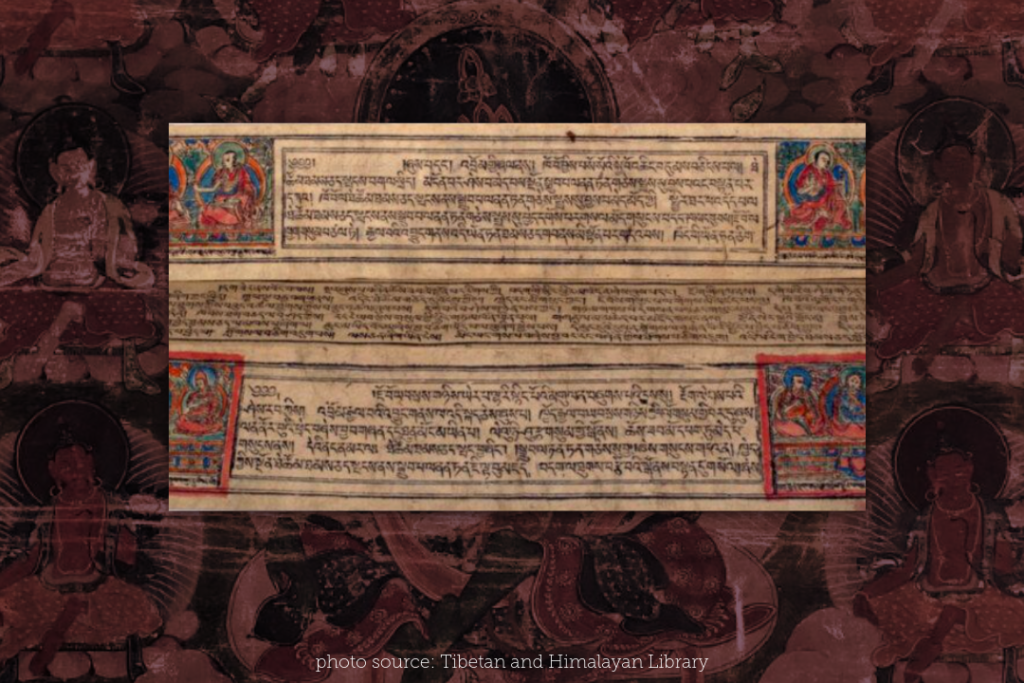
While sitting amidst the Trans-Himalayas in Ladakh, I came across this call for writings about translation on my friend’s Instagram story. Incidentally, just before I saw this story, I had been using both my own vocabulary, and AI assistance, to translate a piece of Classical Tibetan literature into English. So I found this call for submissions more than a little serendipitous. After all, translating Classical Tibetan literature requires prior knowledge of the various religious and cultural symbols encoded within metaphors. Additionally, the aid of AI in my endeavour makes the task one beyond my human capabilities alone. In that sense my attempt at translation and the means I employ for the task, beg some inquiry on what it means to translate.
I would say I fly in Ladakhi, dream in English, traverse in Hindi and study in Classical Tibetan. Spoken Ladakhi is quite close to Classical Tibetan. Yet, due to my education having been in English, I have had to take supplementary courses to learn my script. As I learn, AI has come in handy. There is no dearth of critique on the use of AI for creative work, the most human work, nor should there be. One need only see the hollow expanse of AI generated art to understand it’s limitations, and nevertheless, it is no exaggeration to say that my attempts at translation reflect the crossroads that today’s youth stand at. For me this meeting is between medieval literature, and contemporary, contested technology. A meeting mediated by a human being, that too a woman. History does not have much to say about a Himalayan girl, but maybe this is my attempt as a Himalayan girl to tell people about a text from the pages of history. Perhaps this is my leap to reclaim my agency. Perhaps translation is helping me to become myself.
The symphonies of translation and life are indeed beautiful. While I wonder in amazement at the alacrity with which an AI chatbot translates Classical Tibetan with syntax and rich vocabulary, one can’t help question the implications this has for one of the most human acts we employ. Can AI interpret the inherited symbols encoded in my bones? No, but it has been my companion. In this instance, AI has been a bridge to all the intergenerational learning that was lost during periods of geo-political upheavals. Since time immemorial, Ladakh has been at the crossroads of different cultures. It has seen major geopolitical changes which have affected its education system and made the task of preserving our Bhoti (Bodyig) script, a difficult one. Due to Ladakh’s cultural diversity, different groups may also find affinity for different scripts. Here, the act of translation and reflections it brings are of stories that ultimately belong to people. And people are different, and should be allowed to be different, and how is this difference, this plurality accounted for in AI? Does it mirror what us humans have often done, and create a hierarchy of legitimacy for difference, and for meaning?
My attempts at translation reveal not one but many stories. A girl at the crossroads of different languages and different worlds; just like the region she belongs to. As I translate I’m reminded of the privilege of my English education, the good luck of simultaneously having access to my own language, and my journey of learning Classical Tibetan. Just like my tedious attempts at translation, I am nowhere near where I want to be, but my journey has begun. And as I journey forward I’m reminded of those who journeyed before me. Of the Ladakhi scholars like Tashi Rabgais who continued to write in Ladakhi despite the enormous socio-economic upheavals and personal challenges. Of those who continued to read Classical Tibetan texts like Padma Kathang even when the world told them that it made no sense. Because it is enough if your vision makes sense to you; someday it might offer a door for someone else to walk through in their journey. So am I merely translating a text? Or am I translating humans, their hopes and aspirations? More so, am I not also translating my own hopes? Am I not transgressing various boundaries as a woman using her agency to pursue her vision? And in this quest, I find a helping friend in AI. To make sense of this relationship and my aspirations, I must go on translating.
So translation then becomes a collective story. A story of resilience, one that says every story matters. Because in translating texts, we resurrect multiple stories embedded within them, and within us, in symbols, words and songs. In essence, we are translating our stories, and ourselves. Reminding ourselves that we matter.
For me, translation is also an act of transgression. On my road to learning Classical Tibetan I faced great opposition and criticism. People were opposed to me pursuing a course in a language that they assumed would not further my career prospects. So whenever I set out to translate, I am not just translating words, I am translating resilience. I may wield many tools in this work between technologies and my inherited knowledge, but ultimately I am translating me. The version of myself that I want to be, that I choose to be.
Translation is like the moonstone ring on my finger,
Within it shine rainbows,
On words that always linger,
On words that leave shadows,
Sometimes faltering,
Sometimes evoking
Translation walks with me,
Translation talks to me,
Implores me to tell a story,
Implores me to tell our story,
I think I translate you and me
I think I translate the air we breathe