
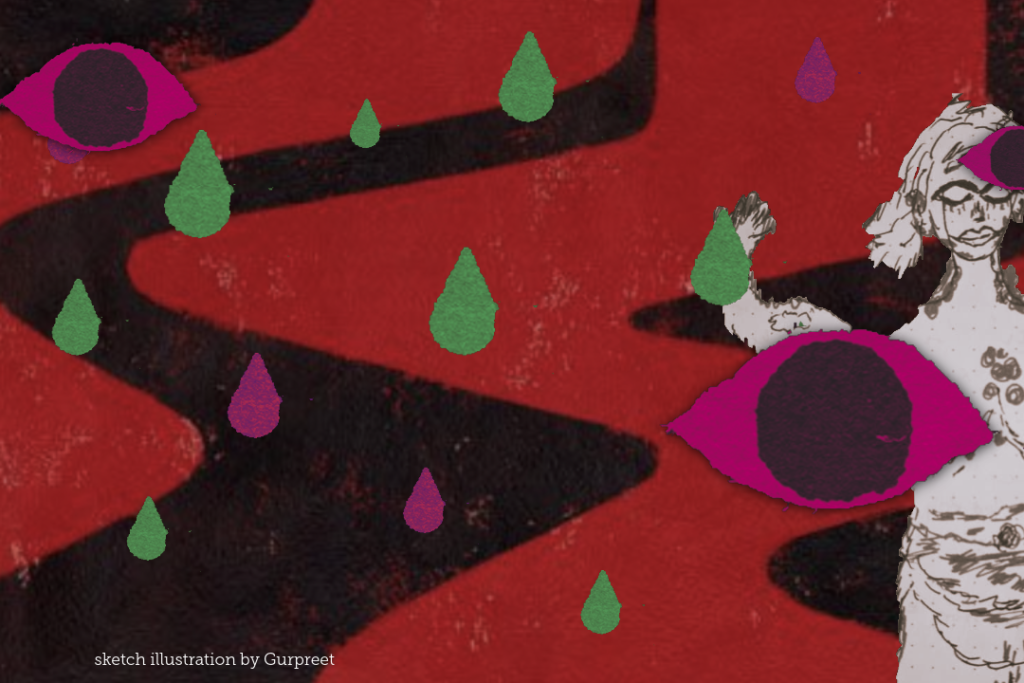
‘Sick Woman Theory’ borrows from the essay by Johanna Hedva of the same title. Hedva reframes the figure of the “sick woman” to encompass everyone excluded from the assumption of wellness and productivity, pointing out that capitalism thrives on bodies deemed disposable and makes care invisible. She argues that illness, disability, and care work are not marginal issues but deeply political, insisting that “the body and mind are sensitive and reactive to regimes of oppression, particularly our current regime of neoliberal, white-supremacist, imperial-capitalist, cis-hetero-patriarchy”
Here I endeavour to articulate our “sick woman theory,” a theory of intergenerational fatigue, of illness residing in our bodies, hidden and untranslated, exploring how we hold and care for one another while continuing to write, listen and translate our pain. ‘Sick Woman Theory’ became a text, a piece, a theory that enabled, opened, allowed translations within and for bodies that are invisibilised.
*
Bhoomi was suffering acutely from her period pain and wasn’t able to move her body. This was a common experience I’d heard from my other female bodied friends, including my sister whose menstrual pain would start almost 10 days before her period, and linger on much after.
I could hear Bhoomi crying over the phone. A friend was taking her to a better, well-known (also expensive), gynecologist in the city. I could hear the desperation in her voice as she said “I really hope this person is able to understand my pain.” Her desperation was for relief and to be seen in her pain. I prayed for both to come.
The gynecologist put her on contraceptive pills to stop her period and the pain for the next few months. I remember my sister was prescribed the same ‘treatment’ of contraceptive pills. Neither of their doctors spoke of endometriosis. In other words, NO conversation about pain in their bodies. We were left to sit and discuss where, what, when the pain was emerging, on our own. Through research online, Bhoomi found similar stories and struggles of pain that named what she was experiencing as ‘endometriosis’. Stories of acute pain, undiagnosed by doctors and with limited treatment plans. In those virtual stories shared by women from across different geographies, social locations, cultures, she felt seen. We cried together, listening to this pain.
Concerns about the effects of contraceptive pills on our hormonal systems, sat alongside fears of the pain. A bargain between short term relief and long term damage had to be made. An illustration of the lack of knowledge of women’s bodies, and the lack of choices available to such bodies. (While this piece writes from the experiences of female-bodied persons, it is important to recognise that ‘sick woman theory’ serves as a manifesto for understanding pain within alienating structures faced by all marginalised bodies; it does not therefore invoke ‘woman’ in an essentialist way). We learnt about our bodies in those moments, through the erasure of our pain by the medical system, and by our attempts to hold, remember and record these experience(s).
We remembered that a woman’s bodily pain has never been understood. Perhaps because it is always seen through a male gaze that centres male bodies. There is too much blood and emotion in the pain of women’s bodies. It is far easier, more convenient, for doctors to find ways to put a lid on it, just like the contraceptive.
Don’t bleed and there will be no pain.
No one is really bothered about how that fucks up with your hormones and moods. My sister feels as though she is in a perpetual mood swing, her panic-free moments being a scarce exception.
And the pain triggered by endometriosis, followed by the absence of recognition of it, continues to take different forms, moods, struggles.
*
For as long as I can remember the women in my family, including myself, my sister and my mother, have chronically suffered from migraines and tension headaches. Both of them experience this pain more than me.
My sister started having headaches in her primary classes and found it difficult to study or sit through exams. Her teacher would say she is a bright kid, but is ill all the time. She was called “too sensitive”, once by our uncle when falling ill on a family trip. Again too much emotion, too much pain, not the ideal pleasing good girl.
My mother was also labelled a sick and hysterical woman. A common label often attached to women, queer and neuro-divergent folx throughout history. In the nineteenth century, behaviours that diverged from domestic roles such as disinterest in housework, refusal to submit, or expressions of emotion and pain, were routinely medicalised as illness or hysteria among women. “Female hysteria” became a catch-all diagnosis for fainting, nervousness, fatigue, or irritability, overwhelmingly assigned to women. Rooted in the Greek hystera (womb), the term marked female bodies as unstable or excessive. Within this framework, any behaviour that resisted the ideal of the passive, domestic woman was interpreted as sickness, a mistranslation that pathologised difference and silenced dissent.
In both colonial Bengal and Victorian Britain, women were institutionalised for defying domestic or maternal expectations, their suffering reframed as madness rather than resistance. This history of labelling emotionally “excessive” bodies as hysteric aligned seamlessly with the rise of capitalism, imperialism and neoliberal regimes that tied wellness to productivity. As Johanna Hedva puts it, under capitalism the “well” person is simply the one who is “well enough to work”, while the “sick” person is the one who isn’t.
As a child I remember watching my mother scream in pain and anger, and my father, and uncle laughing at her, joking about the angry woman she was. Because anger coupled with pain made the woman of the house a hysteric. Moments like these reveal how institutions of marriage and family become bodily and structural sites of control. Expectations of silence, compliance, domestic labour, emotional invisibility determine the ‘health of the household’ or otherwise ‘dysfunctionality’ can prevail. Women’s bodies in the household are shaped by demands that mirror the disciplinary gaze of institutions. As Michel Foucault explains in “Discipline and Punish: The Birth of the Prison”, power works not just by forbidding or punishing, but by shaping people into “docile bodies” through subtle, pervasive discipline, surveillance, regulation, normalisation of behaviour. In this view, the family becomes a micro-institution where the body is disciplined- when a woman resists the domestic place, complains of bodily distress, or expresses anger, her behaviour is “translated” into illness/pathologised or considered laughable and non-serious. Feminists have often used Foucault’s framework to show how the female body is particularly subject to such disciplinary power. Thus the label “hysteric” is not a neutral medical term, it is a disciplinary device that pathologises behaviour deemed non-normative in the domestic institution, silences complaint, and binds the body into compliance.
*
While all the women in my family suffer with chronic pains and fatigue, we avoid doctors, perhaps a privilege of distancing ourselves from a system of care that has long neglected our bodies. Studies repeatedly show how women’s pain is routinely dismissed by the health system, and how the consequences are often serious and fatal. When women’s pain is not trusted, it means their bodies become sites of erasure – symptoms are minimised/dismissed, help is delayed, diagnosis may never come, and preventable suffering or death can follow. The refusal to protect, believe, or treat these bodies isn’t just negligence, it’s structural violence. Kaye Mitchell deepens our understanding of how shame, mystery, morality and stigma are entwined with women’s chronic illness. Mitchell’s work shows us how chronic fatigue, bodily suffering and emotional distress are often cast as ‘psychological’, ‘hysterical’, ‘lazy’, or ‘too much feeling’; labels that render women’s experiences epistemologically untrustworthy.
This mistrust of our pain has been prevalent in our experiences with doctors, who are most often male. I have been fat shamed every time I have seen a doctor for pains felt in my body, my stomach, my head. One told me , “March is a pleasant month, you should go for exercise or just do a brisk walk”. As if pain can be cured with a brisk walk and fresh air. What he prioritized was not my pain, but his view of my body, “a body like yours should be exercised’’. One doctor offered to make me a diet chart in response to any logical explanation of my pain. And I used to believe them. ‘Maybe it is all to do with my fatness’. And if a doctor were to tell me that today, I may still believe them. EVEN TODAY.
That is how internalized the shame is of a fat body. A fat body is bound to be ill because healthcare is a patriarchal institution that does not know what to do with a woman’s pain, and that too a fat woman, other than to pathologize her.
We, the women in my family, have also carried chronic depression and melancholic personalities through and across our bodies. This is not ‘individual pathology’ but emerges from the structure of expectations to endure, nurture and shoulder invisible emotional labour, and still function within a productive economy that places enormous strain on already-marginalised bodies. Under capitalism, care is eroded and commodified.
Reproductive labor and unpaid emotional work are foundational yet invisible. And at the same time, care work becomes subject to capital’s logic – marketised, delegated, devalued. Wellness becomes the default not because it’s natural, but because capitalism demands bodies fit to work: illness, fatigue, the need for care are treated as failures, as the cost of ‘dysfunctional’. When care is individualised and monetised the collective dimension of recovery and repair fades away. Chronic pain, fatigue and melancholia are invisibilised and normalized rather than addressed. Because these conditions disproportionately affect women, queer, neurodivergent and other marginalised bodies, the cost of this structure is deeply gendered.
We, the women in my family, continue to struggle with disappointments in structural invisibilities, in unavailable spaces of care, and in relationships where we remain invisibilized. My mother suffers from abandonment by her mother and siblings, my sister struggles with failure in her relationships, and I mostly find myself in an existential dread and crisis. And yet we continue to ask each other every morning, “did you sleep okay, is the head hurting?” It is a routine now. The head hurts. Sleep is a maximum of 2 hours or 4 hours. And we manage to be in a world that continues to un-see us.
Perhaps existing as ‘sick women’ is our only way to exist, and also resist.
Perhaps existing as ‘sick women’ is caring for each other when the world refuses to care for us.
Perhaps existing as ‘sick women’ is seeing each other in our sickness despite oppression and inequality.
Perhaps existing as ‘sick women’ is crying and breathing together in a panic attack. Is standing with each other in our grief of being un-seen.
Perhaps existing as ‘sick women’ is to protest in our existence and tell the world that we will continue to exist and survive even when we were not meant to.
.
.
.
.
.
References
- Hedva, J. (2016, January). Sick Woman Theory. Mask Magazine.
- Last line inspired from Audre Lorde’s poem ‘A Litany of Survival’.
- Mitchell, K. (2020). Writing Shame: Gender, contemporary literature and negative affect. Edinburgh University Press.
- Foucault, M. (1977). Discipline and Punish: The Birth of the Prison (A. Sheridan, Trans.). New York, NY: Vintage Books.