
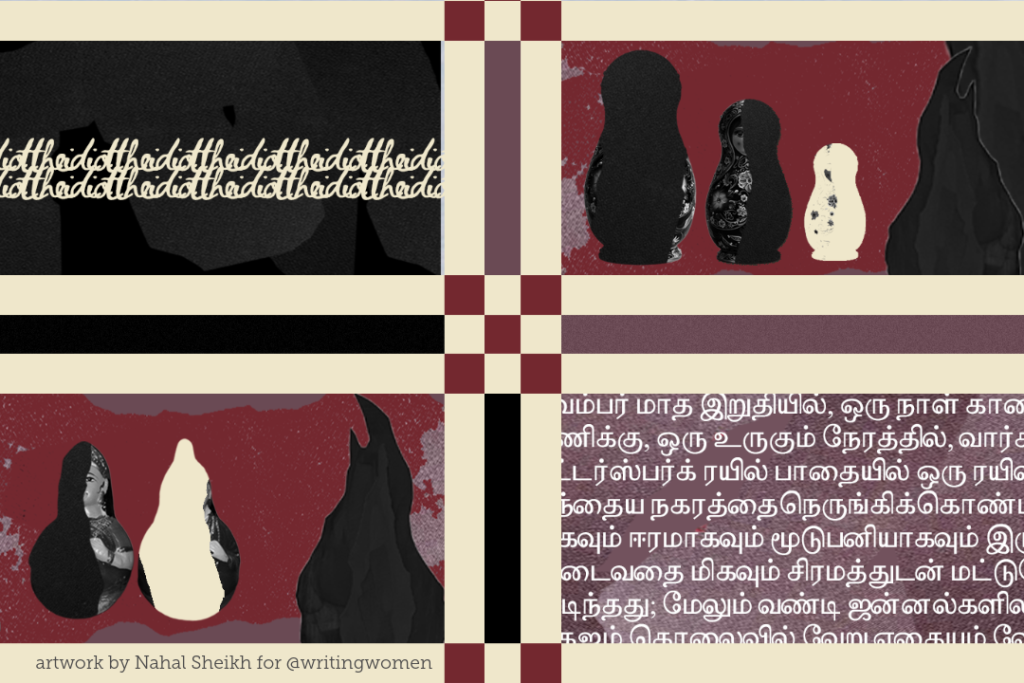
On cold winter nights in Delhi, a Russian Idiot, an English Idiot, a Tamil Idiot and I would sit on the floor near the defunct fireplace in the drawing room of our government quarters: a literal quarter, carved out of a colonial bungalow once built for a single British sahib, now sliced into four homes to house four Indian families, as my grandmother sat working. She was translating Dostoevsky’s The Idiot to Tamil. I was barely eight at the time; old enough to laugh at the word idiot but too young to understand Russian despair. My grandmother is a Tamil writer and translator. I call her Susima, a child’s portmanteau of her name Susila and amma, stitched together like most things in our house. While she narrated how Nastasya Filipovana threw rubles in the fireplace, my brother and I were too busy building card-houses in our own fireplace, which hadn’t seen a fire in decades, and now functioned as a shelter for the delicate architecture born of our winter vacation boredom.
Translation has always been a part of my life. We all spoke different languages in my family. I never quite mastered Malayalam, my paternal family language. I could follow its musical intonations and I had mastered nodding my head to keep up with its rhythm so no one would suspect ignorance, I could never really speak it. My Tamil is passable as my mother tongue, although one would be disappointed if they were expecting that I had inherited my grandmother’s clarity and command over the language. At best, I am a hesitant borrower of Tamil, patching up gaps in my vocabulary with English and Hindi. Growing up as a South Indian girl in Delhi, I detested Hindi, largely owing to the cruelty of children, which at that age, they are most fluent in. My skin, my hair and my food all became objects of mockery in a language I could barely comprehend. Later, when I would return to Delhi for college, I would pick up Hindi again, driven mostly to understand the daily barrage of catcalls.
In college, I studied History, the kind with footnotes and diligent records, cleanly dated and obsessively sourced. But I also went to a women’s college, Miranda House, where history had a different texture. There I launched my search, as every woman does, for a history of my own and found next to nothing. It wasn’t that women’s histories weren’t there, but they were in a language that had to be translated. A language of mostly silence and illegitimate memory practices. My own mother and grandmother would serialise their lives and narrate them to me as bedtime stories: their college lives, their struggles, their friendships. This too is a source, I realised, no less than any traditional archive. I decided the daughter was the archive. The work of feminist history would require translation. Yes, across languages but also across forms of archives, meanings and memories, from bedtime stories, rumour, gossip, habits, jokes, grief and silences. As a daughter-shaped archive I gather what I can of fragments and mis-remembrances. I translate what I inherit—grief, rage and joy— into language.
This emerging feminist understanding of translation began to change how I approached history. I am drawn toward the unsaid and the affective weight of what we do not record but still remember. Nowhere did this feel more urgent than in the histories of older women’s colleges in India.
Colonial pedagogy and emerging feminisms, both, have shaped these institutions. They hold layers of memory that don’t fit into traditional historical records. In them, I saw the same kind of translation I had grown up with: partial, affective and occasionally mis-remembered. This isn’t a failure, but a deliberate act of feminist refusal. By intentionally ‘mis-translating’ these experiences, women reject patriarchal ideas of a single, objective truth. Translation is never objective. Every act of translation carries within it a negotiation of power, of context, of voice.
When women translate memory into stories, they are not distorting the truth, they’re expanding it. What counts as material, what gets preserved and what gets dismissed, has always been a question of whose voice is deemed legitimate. To write the histories of women’s colleges using these memories would require a method generous enough to hold all the gaps and the grief. Part of what anchors me in this search is intimately personal; I come from a long line of women educated in women’s colleges. My great-grandmother, whom I’m named after, was a child widow in colonial Madras, until social reformer Sister Subbalakshmi intervened and ensured she received an education. She went on to study at Queen Mary’s College. My grandmother taught Tamil literature at Fatima College in Madurai, my mother went to Lady Doak College, Madurai and I eventually found myself, almost inevitably, at Miranda House, Delhi University.
With, and because of, this inheritance, I struggle with the limitations of traditional history. As E.H. Carr noted, history often fixates on ‘facts’ sanctioned by dominant institutions, pushing other truths into a ‘limbo’ of forgotten knowledge. I question this approach, because I know that all facts are interpreted. And in patriarchal systems, only the dominant interpretation is legitimised as historical fact, and the sources I wish to use are pushed aside. I learned that inside the cult of fact, not all truths are welcome. This makes the work of a feminist translation invaluable. I had been hardwired to probe silences, and to dig where things were buried, even if it meant creating discomfort.
However, this kind of translation of history is extractive and clinical. It treats memory like a specimen to be pinned down, catalogued and named. Much like the coloniser, the historian is a man who wants everything in order. Translation becomes extractive when it demands articulation in terms legible to the dominant archive. When the language of the coloniser, the patriarch, the ruling class, the upper caste, the dominant community, the majority and their institutions become the only acceptable syntax of memory. When a story must be sanitised and standardised to be taken as true. This is the kind of translation that seeks to flatten, to control, to overwrite. A feminist understanding needs to undo that impulse. It needs to ask instead, ‘What if the silence is the source? What if not knowing or misremembering is part of the truth, and anything without is incomplete? What if the work is to sit and listen?’
Hannah Arendt’s image of the pearl diver, drawing on Walter Benjamin, is one I return to often. The task is not to dredge up the past in its entirety, but to “pry loose the rich and the strange.” History as an act of retrieval. Not extraction. I think of this often when I sit with the fragments I’ve inherited from my mothers, half-told stories and silences thick with meaning. Translation of these memories, then, is not just an act to carry across, but to carry forward.
Translator Deepa Bhasti, who translated the 2025 International Booker Prize winning Heart Lamp by Banu Mushtaq, describes her approach as translating with an accent. She retains the cultural and historical peculiarities of the original, letting them echo into the English, rather than smoothing them out or translating each of them. It is a refusal to assimilate fully into the dominant language. It is, in essence, an archival politics. A way of saying, this work came from somewhere else and it remembers where it came from.
That is the kind of translation I hope to do, whether I’m translating my grandmother’s retelling of the Ramayana, or writing the histories and stories of women’s colleges. I want to translate with an accent. To let the original hum underneath. To leave some things untranslated or only half-translated out of respect.
Is my historical ‘translation’ of women’s lives a failure? Perhaps, if one believes that a translation must be perfectly loyal to a fixed original. But what if the source is already fragmented and unstable? The kinds of translation we do everyday, across generations, and ways of knowing are never perfectly loyal. So the question of the fidelity of translation is flawed. Fidelity to whom? To the archive, or to the women who were excluded from it? Fidelity in feminist translation cannot mean faithfulness to the rigid original; it must mean faithfulness to the ache.
And with that ache, I return to those winter nights in Delhi, as I sat building card houses in a fireplace while my grandmother sat translating. I see translation now as more than just a linguistic bridge. Translations can traverse time and generations. The repurposed fireplace protected my fragile card house from cold winds; delicate architectures of memories too require shelter and care. Translation and history-writing then become more than simply academic labor. They are a feminist work of retrieval.
To translate, then, is to resist forgetting. To hold close what dominant histories discard. To believe that even the most fragile things, a card house, a bedtime story, or a memory might still stand against the cold winter night.
.
original artwork for the essay is by Nahal Sheikh
.
.
.
References
- Carr, Edward Hallett. 1962. What is History?: The George Macaulay Trevelyan Lectures Delivered in the University of Cambridge January-March 1961. Hartman, Saidiya. 2008.
- Venus in two acts. Small Axe a Caribbean Journal of Criticism 12, Nr. 2 (1. June): 1–14. doi:10.1215/-12-2-1, https://doi.org/10.1215/-12-2-1.