
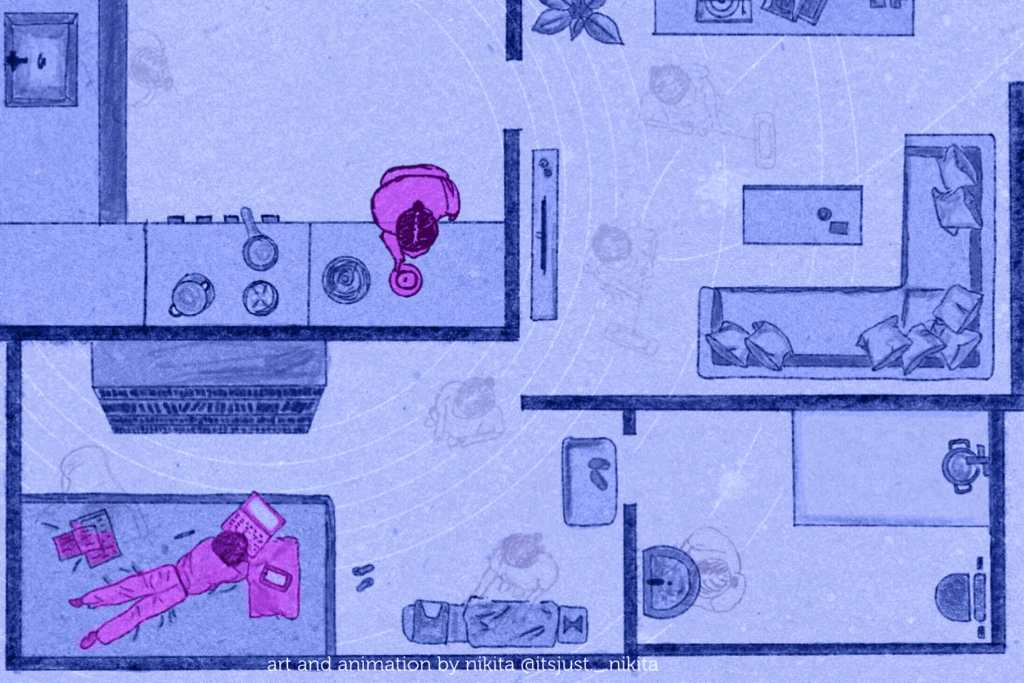
I am seated on my bed, my laptop balanced on my thighs, the heat from the device rising steadily, but I cannot stop reading the text in front of me. The final year of my doctoral journey demands constant alertness—writing, rewriting, and returning repeatedly to ideas I thought I had already settled. A haze of confusion hangs over me. What should I allow to occupy my mind today? The relentless news of bulldozer justice? Nithari victims not getting justice? The humiliation of yet another Dalit student being forced to clean a toilet in Bihar or Tamil Nadu? The revisions pending in my thesis? Or the striking gaze of my domestic worker as she enters my home and finds me in the same spot with my laptop?
There is more in that gaze than I often admit.
The next morning, I wake up on time, freshen up, and prepare to read again. I tell myself I should sit at the study table, like a disciplined scholar, but the exhaustion of living in a polluted city weighs on my body. The bed feels more forgiving, so I settle into the same spot as the previous evening. Zehra (name changed), enters and sees me exactly where she left me. She doesn’t comment, but her gaze lingers. What is this gaze? And why does it unsettle me?
That one look reminds me of the distance between us. From my bed to the door, only a single meter separates our bodies. But in reality, that meter stretches into two entirely different worlds. These two worlds meet briefly, twice a day—when she comes to clean and when she leaves to return to her responsibilities at home. I am reminded of Sujata Gupta’s quotation. “स्त्रियां काम से लौटकर भी काम पर ही लौटती हैं” (Even after coming back from work, women find themselves returning to work again).
Political theorist Gopal Guru, in his work on caste humiliation, describes Indian social life marked by “proximity without equality”—bodies occupying the same space while inhabiting entirely different social worlds. That one meter between us was not a physical distance; it was a caste-class architecture.
As Zehra mops the floor, I sit with an academic text. She may assume that I barely think about the nature of her labour. And in some ways, she would be right: I rarely engage in physical labour, and the pressure of academic work leaves little time to be physically active on most days. The brain fog from constant reading and writing is real, but my struggles fade the moment I meet her gaze. The contrast between her physical labour, and my intellectual labour, was not merely occupational. Dr. Ambedkar, Sharmila Rege, and Gopal Guru have long described this as embodied caste labour, where caste and class are lived through the body, posture, space, movement, and the distribution of labour. Gopal Guru, in his article on “Experience, Space and Justice”, argues the centrality of social meanings embedded in a space pushes us towards formulating an understanding of an experience.
Zehra is a scheduled caste migrant from the Hardoi region. Like many domestic workers in north Indian cities, Zehra migrated from rural Uttar Pradesh in search of steady income. She was married as young as fourteen years old. She has rarely taken leave since joining, a practice she frames as personal discipline: “I don’t like taking leave. I finish my work here and then go home to look after my kids.” It wasn’t an empty claim, yet this self-description must be read alongside the absence of formal or legal protections, where the costs of absence are often borne disproportionately by domestic workers. She arrives each day in a neatly draped cotton sari with blouses that echo a Fab India aesthetic, an intentional style that asserts her dignity. Zehra doesn’t wait to be told what to do. She rings the bell before entering, even though she doesn’t need to. She values kindness, the small, consistent gestures that make labour bearable. Sometimes she mentions her children who go to school. “I am doing this labour so that they can study,” she says. In those moments, her voice sounds like my mother’s. My mother, a homemaker, spent her entire life ensuring her children were educated, shielding me from domestic chores so I could focus on my studies.
Their stories differ in structure, caste, and class, but their aspirations overlap: both want their children to live with possibility. Both are Dalit mothers who wish for their children to transgress the hyperbole of being trapped in a life cycle where women’s labour remains invisible.
Zehra’s labour forms part of India’s vast but invisiblized domestic work sector. Labour that feminist theorists argue is central to sustaining the very possibility of middle-class intellectual work. Our lives are intertwined through what scholars call the politics of care work—a system where some women’s labour enables other women’s mobility, education, and productivity. Silvia Federici and feminist labour theorists remind us that intellectual labour often rests on invisible “care work” performed by others, usually marginalized women. Official government survey data from the National Sample Survey Office (NSSO, 2012) recorded 3.9 million domestic workers nationally, of which 2.6 million were women. Their work keeps urban households running, yet it remains informal, underpaid, and unprotected.
These numbers matter because they reveal what Zehra’s gaze hints at: domestic labour sustains lives like mine, yet it rarely enters public or academic conversation. Her presence enables my reading, writing, and thinking. Without her daily labour, my time and attention would be distributed very differently. Domestic work is what some sociologists describe as a “labouring intimacy”: close enough to shape the rhythms of everyday life, yet distant enough to remain unacknowledged in public discourse.
But the reverse is not true. My labour does not enable her children’s education or her survival. That asymmetry is uncomfortable, and it should be.
One morning, as she scrubbed the floor and I typed furiously, I caught her looking at me again. Not with resentment, and not exactly with envy; it was something more layered. A look shaped by class, caste, gender, distance, and perhaps a curiosity about a life in which one can sit and read for hours and call it work. Dalit feminist writing often speaks of the destabilising power of the upward gaze, when a woman from a marginalised community looks back at privilege, not submissively but knowingly. Zehra’s gaze unsettled me because it inverted an old hierarchy of who gets to look, and who must be looked at.
Her gaze prompted a question I keep returning to: who gets the privilege of intellectual labour, and who must perform physical labour so that others may think?
Dr. Ambedkar wrote extensively about how caste reproduces itself not only through violence but through the everyday division of labour, touch, and bodily hierarchy. The kitchen, the home, the domestic wage, these are the insidious theatres of caste socialization. My encounter with Zehra was not dramatic, but it revealed the everyday asymmetries that structure Indian life.
In that moment, I realised something that should have been obvious. My doctoral journey, which often feels lonely and self-contained, is not solely mine. It is built on the unspoken support of people like Zehra whose labour creates the conditions for my labour. She may not be present in academic panels, conferences, or anthropological debates about urban space and caste, but she is present in my everyday life in ways those panels rarely acknowledge.
Her gaze, then, is not simply a look at me on my bed with a laptop. It is a persistent reminder of the structures we inhabit and the inequalities we live alongside.
If ethnography is about paying attention, then perhaps it must begin at home, recognising the violence of writing when the backdrop has individuals who are forced to work under precarious conditions. It should start by acknowledging the people whose lives intersect with ours at the most intimate level, yet remain the most overlooked. If I continue to write about caste, labour, and inequality, I must remember that every sentence I produce is tethered to labour I do not perform but that sustains me nonetheless.
And maybe true reflexivity lies in not only recognising the one meter of distance between us but considering how we might traverse this distance. Maybe it is about nurturing spaces for collective reflectivity shaped by mutual recognition and respect. And once we acknowledge privileges of class and caste, and care, it is asking what we will now do to dismantle it.
.
.
art and animation by nikita, @itsjust._.nikita
.
.
.
References
- Ambedkar, B. R. (1936/2014). Annihilation of Caste
- Federici, Silvia. (2012). Revolution at Point Zero: Housework, Reproduction, and Feminist Struggle. PM Press.
- Guru, Gopal. (2009). Humiliation: Claims and Context. Oxford University Press.
- Guru G. & Sarukkai S. (2017). The Cracked Mirror: An Indian Debate on Experience and Theory. Oxford University Press.
- Lefebvre H. Nicholson-Smith D. & Harvey D. (1991). The production of space. Blackwell Publishing.
- Rege, Sharmila. (1998). “Dalit Women Talk Differently: A Critique of ‘Difference’ and Toward a Dalit Feminist Standpoint.” Economic and Political Weekly, 33(44): WS39–WS46.
- Rege, Sharmila. (2006). Writing Caste, Writing Gender: Reading Dalit Women’s Testimonios. Zubaan.