
“The stitching circle offered a space for people with similar questions on their hearts to meet. It reminded me that many of us are walking parallel paths and that we’re just an arm’s reach from one another. It affirmed to me that meaningful connections can be rooted in fighting for our communities together.” – Cat Lau, a participant from Bangkok
With every stitch, Kantha represents a refusal to discard and a renewal of purpose. Historically, women in South Asia stitched together worn saris and old cloth, layering fabric over fabric until something new emerged. Known as Kantha in the Bengal region, the same practice found many names across the subcontinent but the underlying principle remained the same. Nothing was wasted. Every thread had a second life and came together to craft a re-imagined future.
I was thinking about movements in this way when I began designing the Kantha Connections stitching circles in 2025.
Each circle is rooted in a local community and cultural space, and always in conversation with something travelling. Access is intentional with circles either offered free of cost or for a token amount that goes to a value aligned cause. This is the Kantha logic made literal: pieces from different places, stitched into a shared fabric, to make something new out of something old.
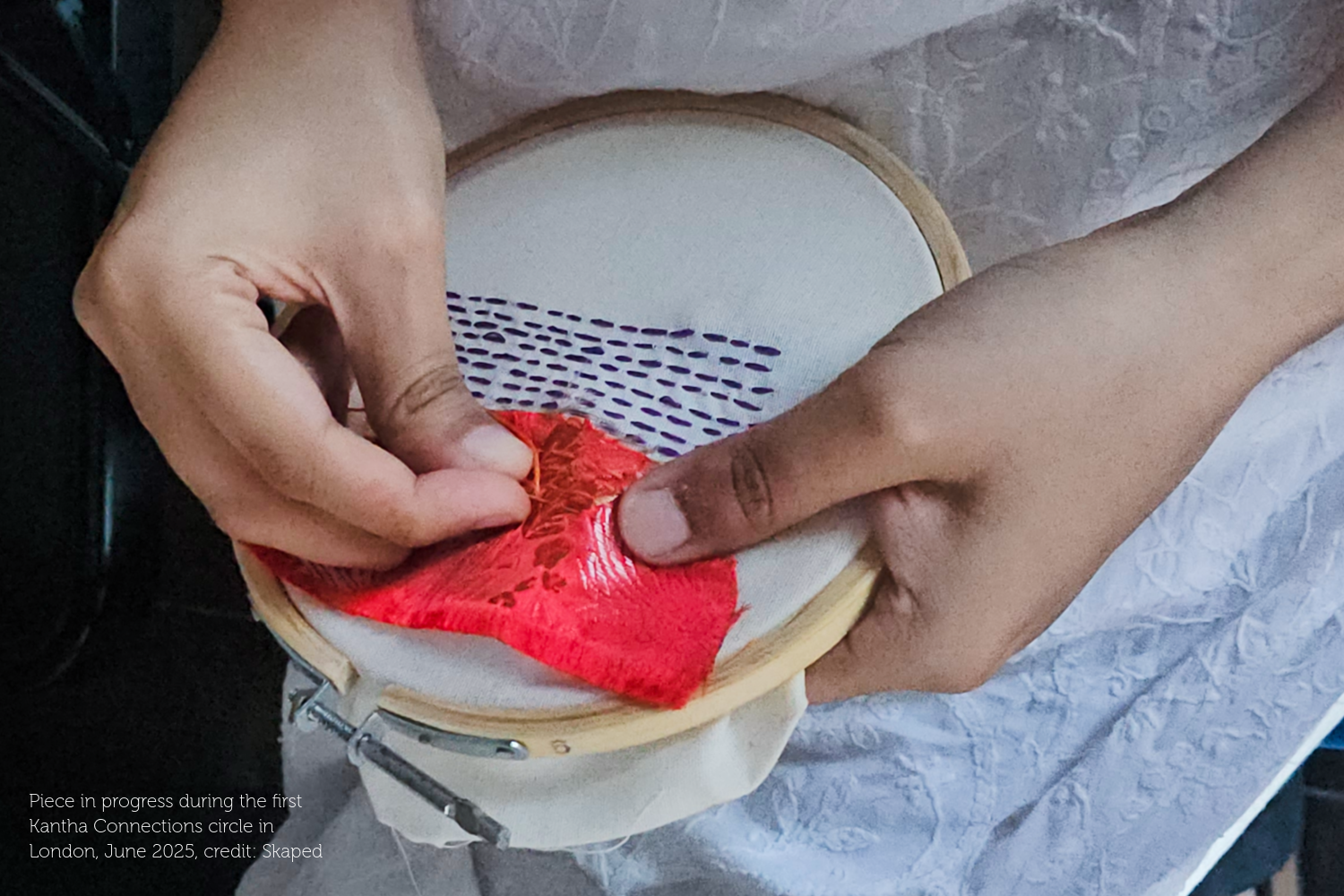
We began in London with Skaped, where artists and activists from the Indian and Pakistani diaspora came together to reflect on our shared heritage through stitching. From there the circles travelled across three continents: Africa, Europe, and Asia. Each partnership brought its own community into the room and each room became something none of us could have made alone.
Settle
In a world that rewards urgency, to sit in a circle and stitch is a political act.
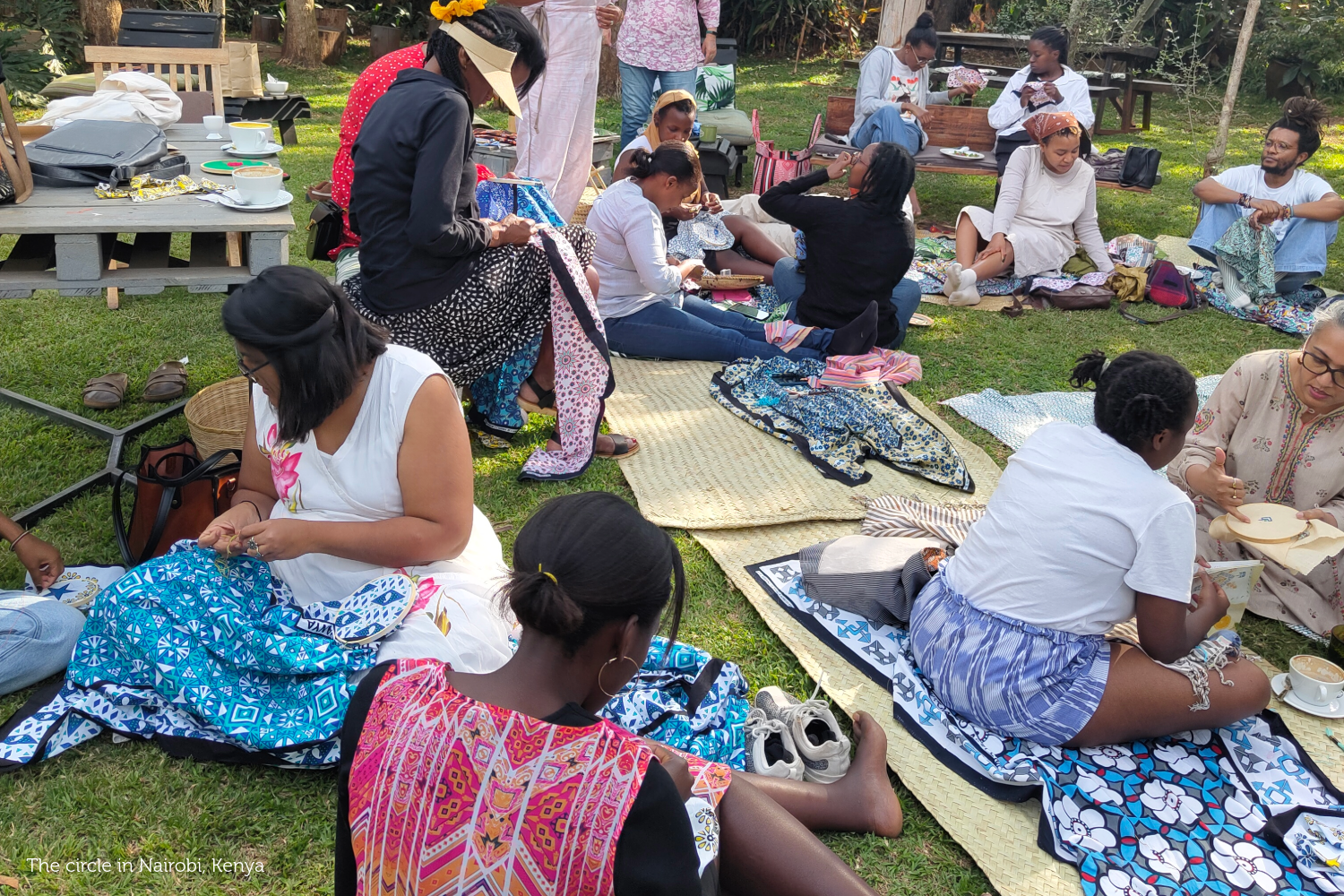
“The stitching pulled me out of constant thinking and into a steadier rhythm, present into the space I was in. When hands are busy, people open up differently. The space felt calm. Creative, but not performative.” – Joy Njeri, Kenya
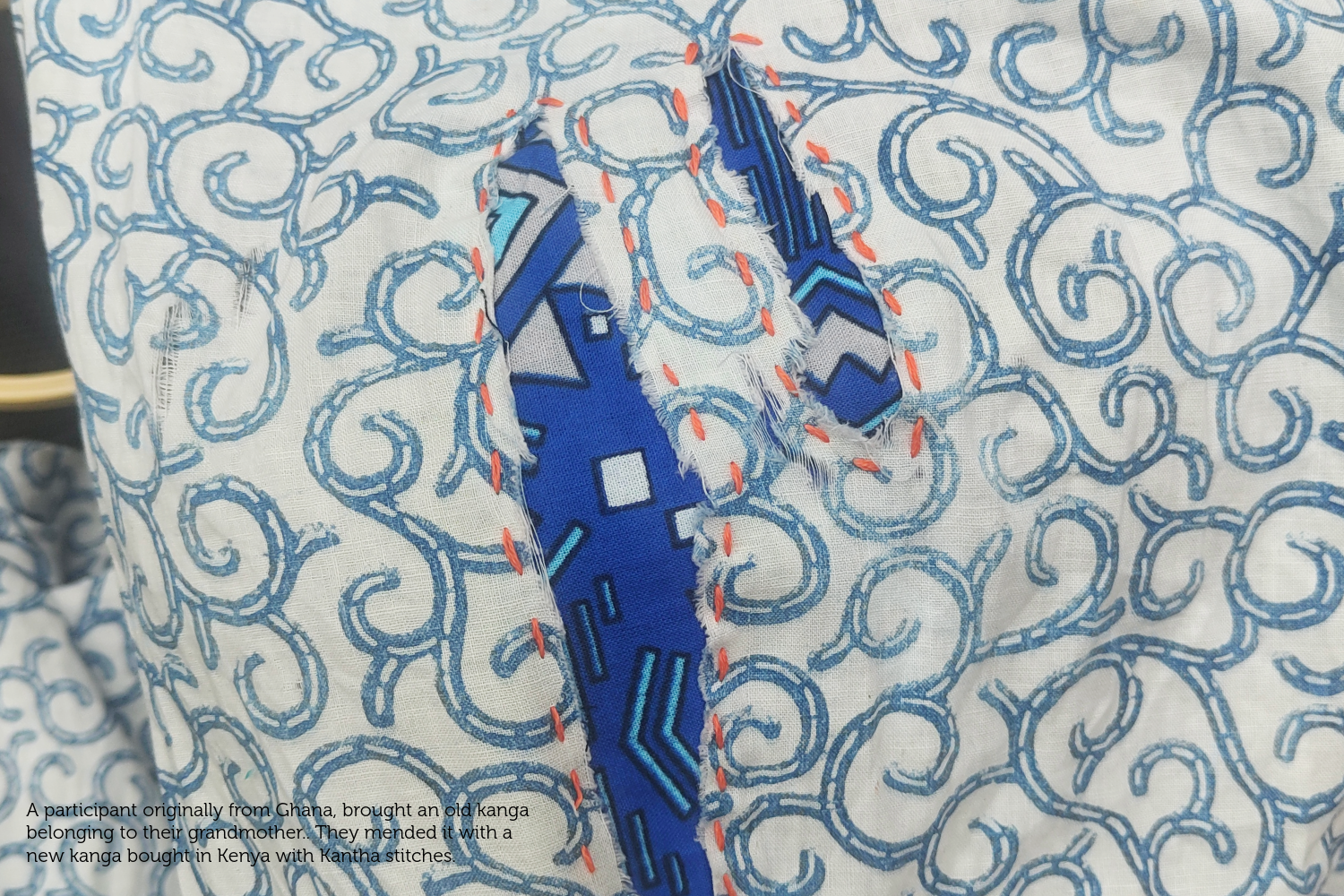
At the circle in Nairobi, hosted with Provisions Kenya, participants were invited to bring a kanga (a square or rectangular fabric commonly used in East Africa) with them. We sat in community, building on the interconnections between our nations through our textiles, our histories, and our practices. The conversation didn’t follow an agenda. It moved the way it needed from personal stories into questions about history and identity, carried by the rhythm of hands at work.
Something similar happened in Paris. Michele Chung arrived at the circle hosted with Serve the City with a lot on her mind. Around her were participants from Iran, Armenia, Spain, the Philippines, China, and Ethiopia.
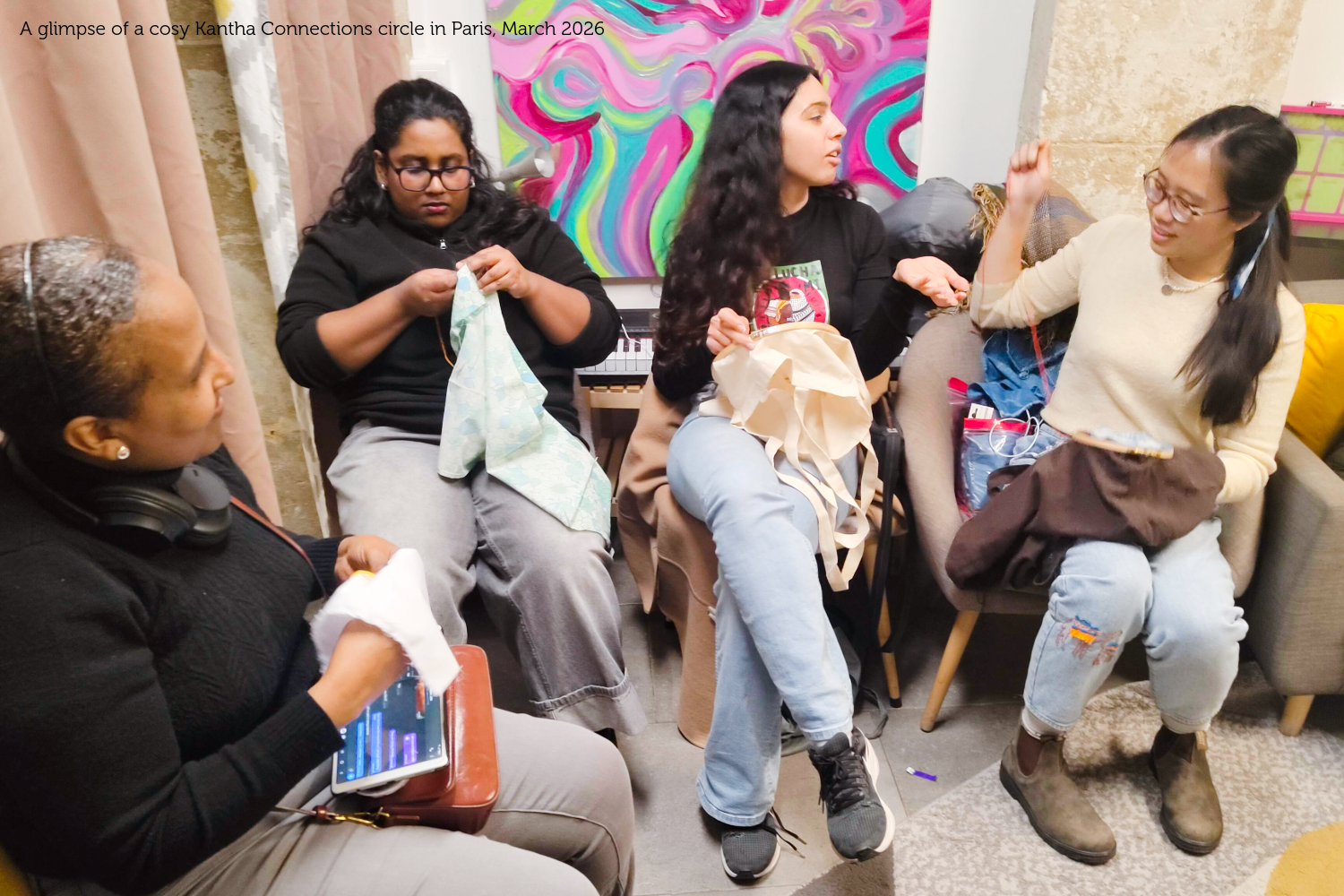
“There’s tranquility and solidarity in a circle with people telling their own stories through stitching while chatting and laughing. There were a lot on my mind that day but the process helped calm my mind and gave me the peace I craved for a while. I’ve been stitching every day since.” – Michele Chung, Hong Kong / Paris
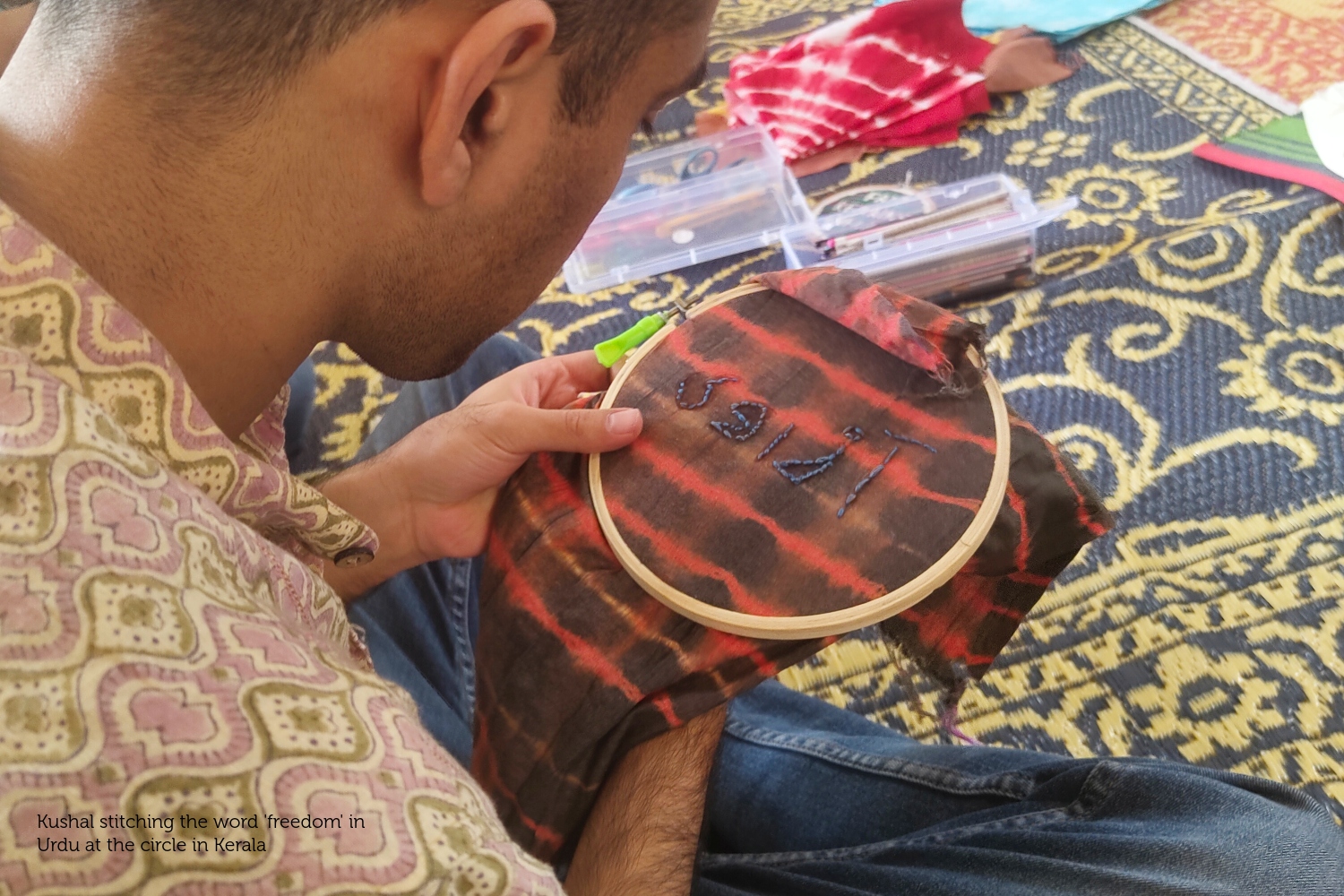
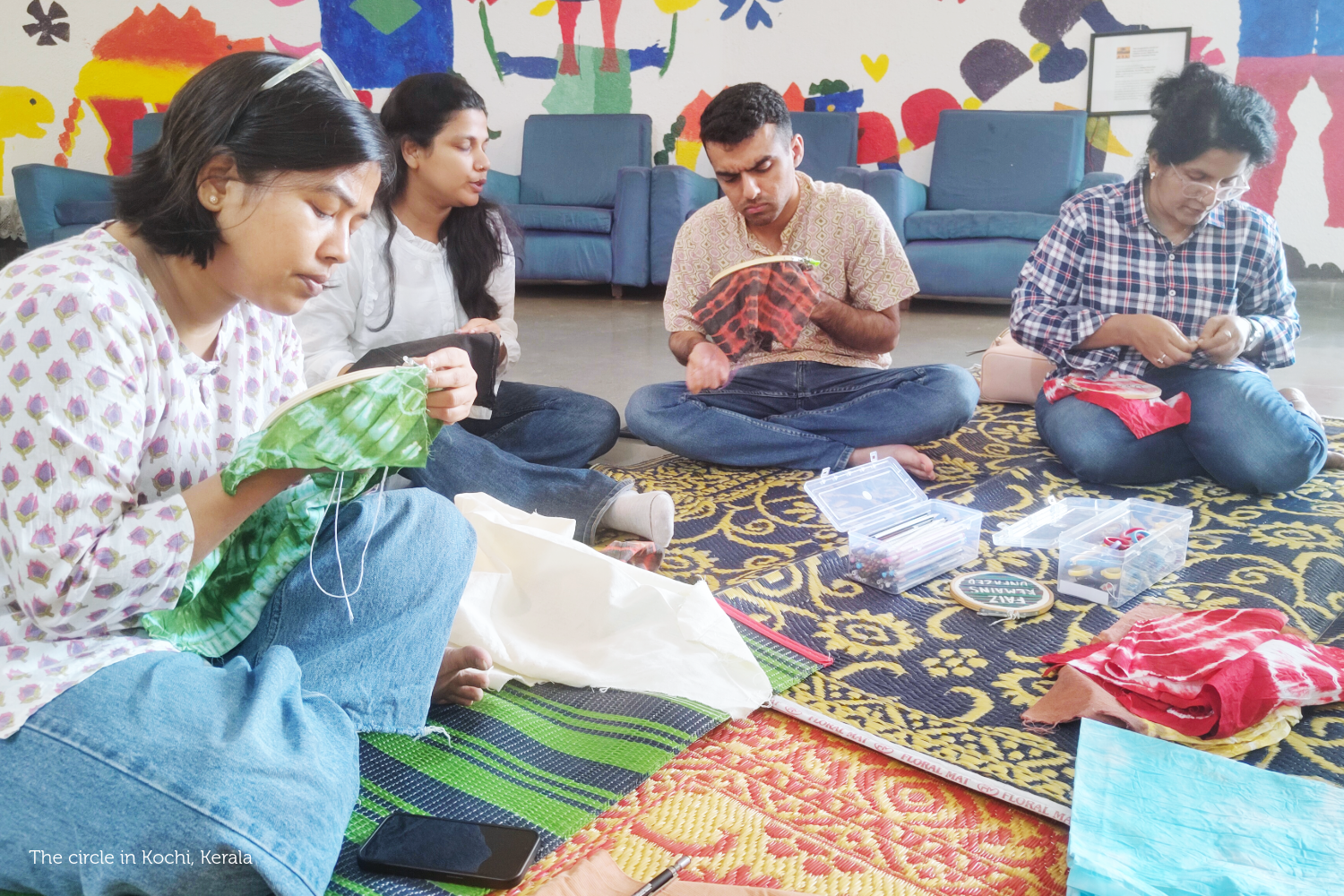
Kushal Sohal was one of the rare male-identifying participants across these circles, joining the one hosted with Kerala Museum. He sat with a question that the circles tend to surface without quite meaning to: who gets to slow down, and who doesn’t.
“Much is to be found in pausing, conversing, and stitching in community. Embroidery as a sector of work is not without men. And yet, so few such folks attend these gatherings. This is a particular expose of what ‘leisure’ often is and is not within the paradigms of dominant cis-het masculinity.” – Kushal Sohal, UK/India
Hold
Fabric never forgets. It carries the energies and histories and dreams of the hands that made it, the body that wore it, and the culture that named it. At the Kenya circle, Joy shares how the conversation moved through the kangal, a fabric that used to connect our countries during colonial times when India was the largest exporter, but has now been surpassed by China.
“We spoke about indigenous African fabrics and how much has shifted. Leather and wool once held context and meaning. Today, many materials feel detached from place. The kanga’s patterns carry memory. Coastal histories. Language woven into design. You can trace change through the prints if you pay attention.” – Joy Njeri, Kenya
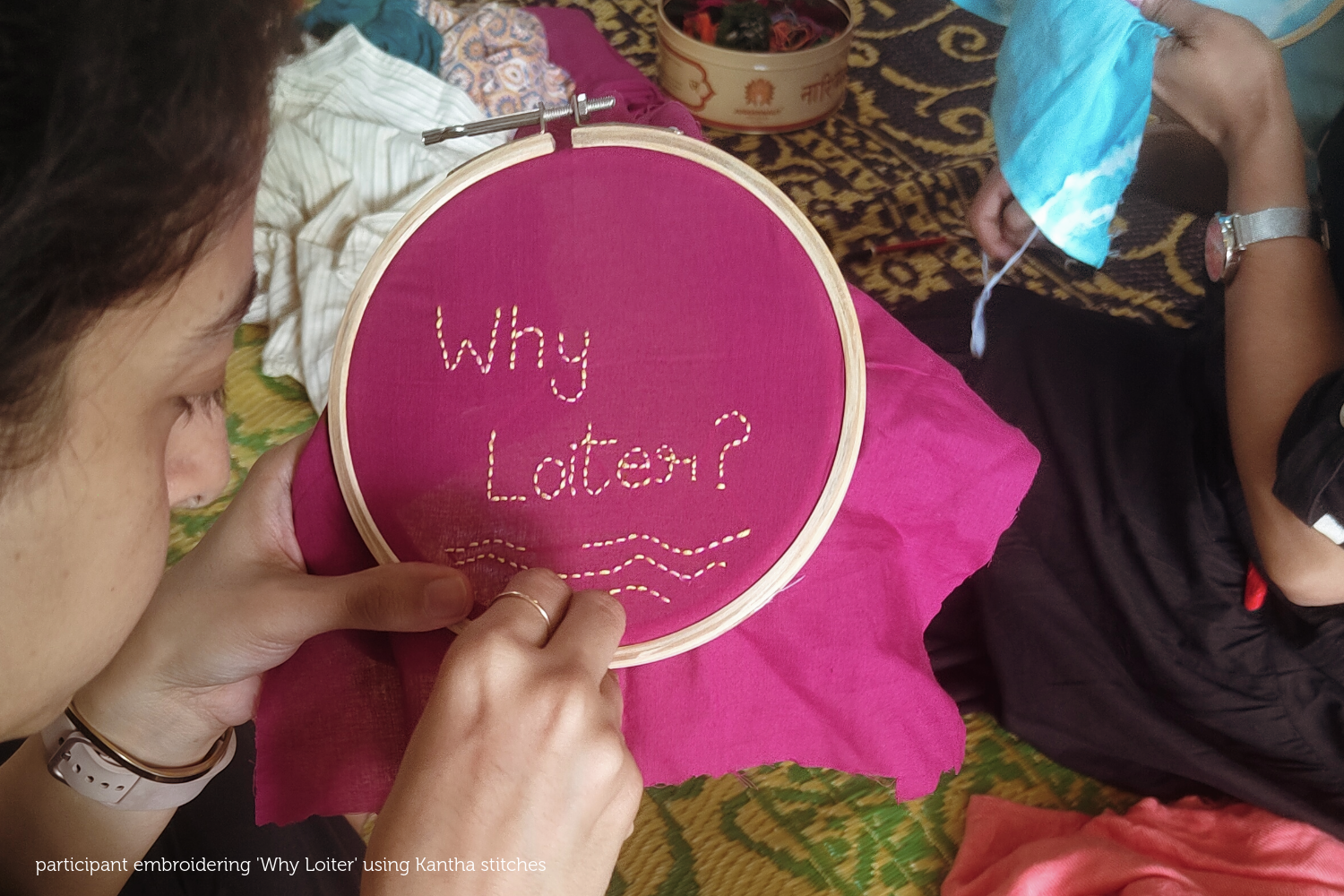
The Kerala circle, hosted with Kerala Museum, drew connections between agrarian resistance movements in Punjab and Kerala talking about the long histories of land, labour, and refusal that run through both. Participants spoke about Nangeli, the nineteenth century woman from Kerala who is said to have cut off her own breasts in protest against the breast tax imposed on lower-caste women and their resistance to be able to cover their breasts with fabric. A participant connected this to the “Why Loiter” movement in India which reclaims public spaces for women.
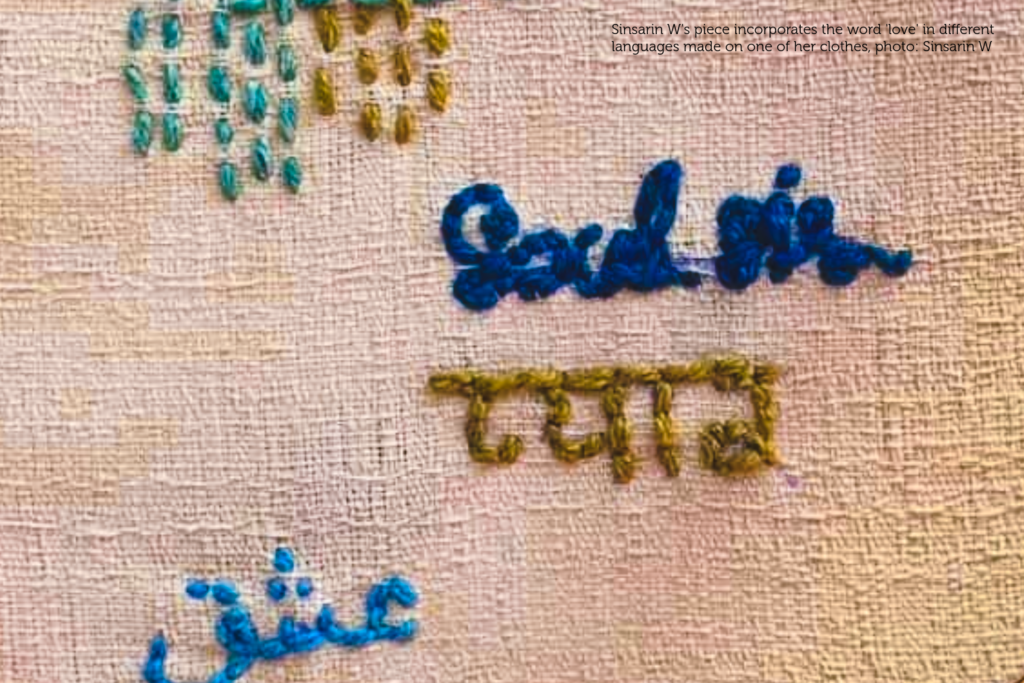
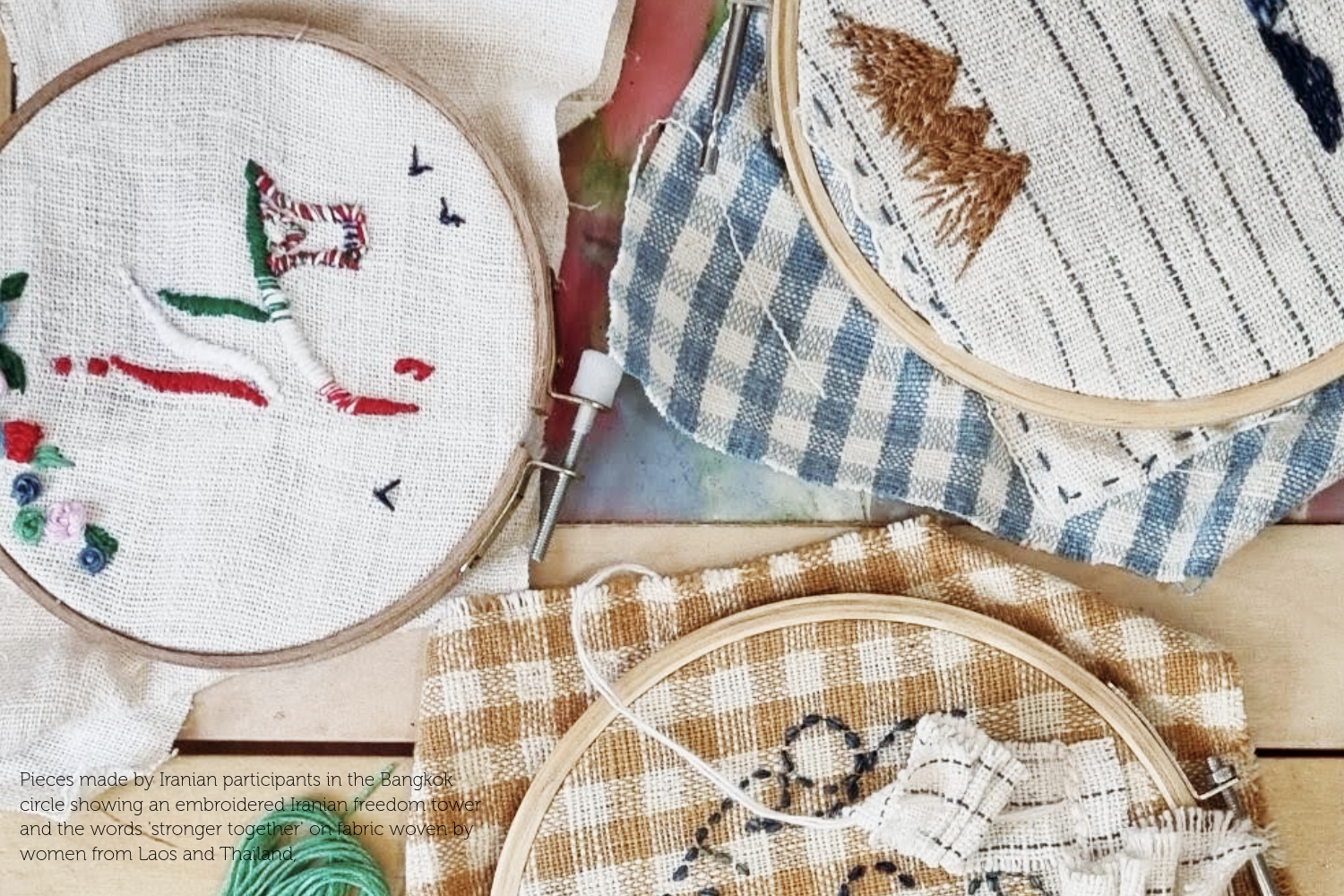
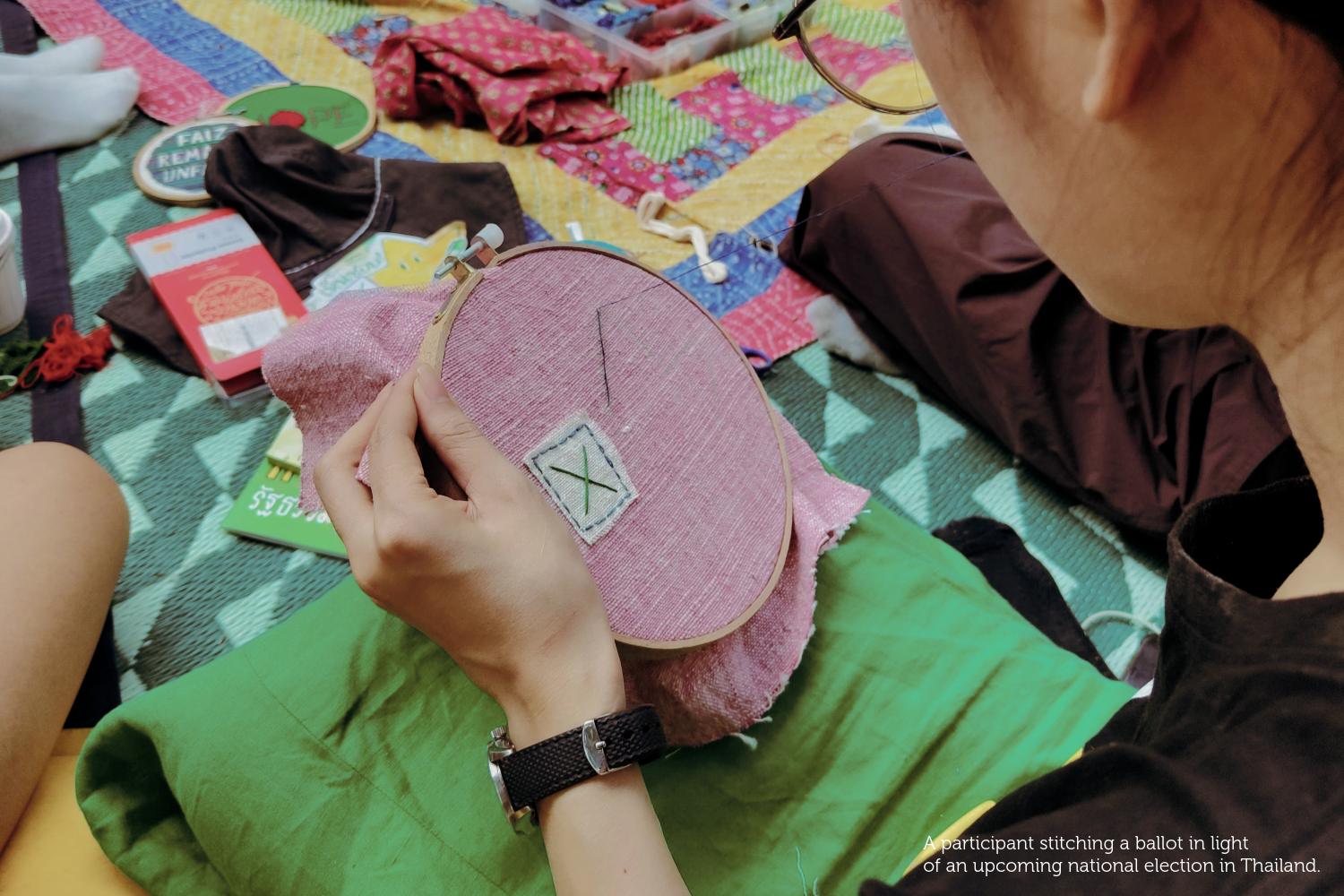
For Sinsarin W, who joined the Bangkok circle, co-organised with Bangkok 1899 and Rachna of Tikkiwallah, the relationship between cloth and testimony is at the core of her practice. Rachna brought fabrics woven by women from ethnic communities in Thailand and Laos in the room held by people from Iran, India, and Thailand.
“For me, embroidery is a form of storytelling, like drawing or writing poetry. Through each stitch, I speak of violence, hope, and love. I am drawn to the way something so gentle can carry pain with such power. People often see only the beauty of the finished work, never the wounds behind it. Women’s stories are much the same.” — Sinsarin W, Thailand
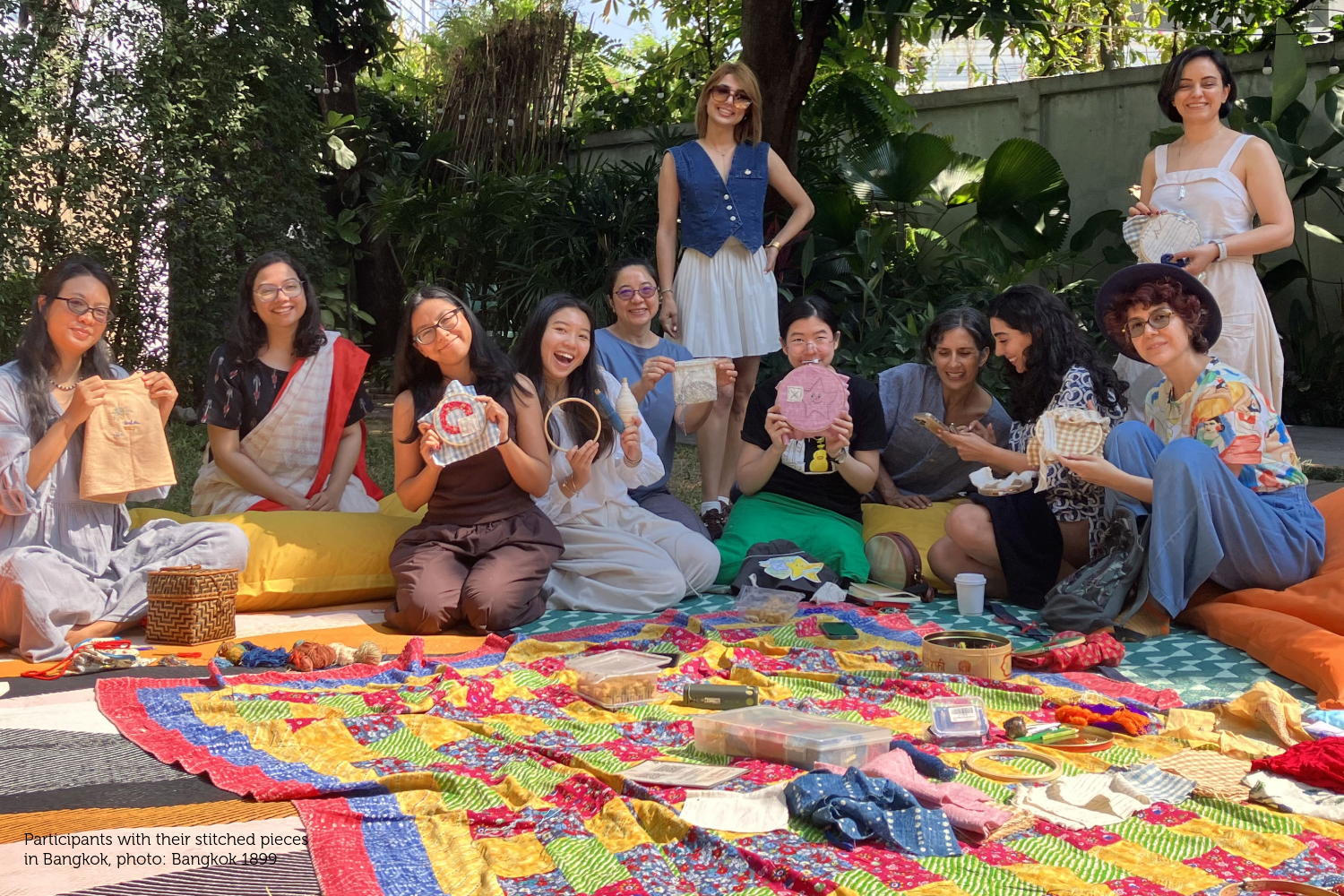
That circle was held in January 2026, when Iran’s resistance movement was gaining momentum and the country was under a nationwide internet blackout. Several participants from Iran were living in Thailand, unable to reach their families. Their hope in the movement and their fear for the people they couldn’t contact found its way into the textile pieces they made that day. The sharing led to deep conversations around what it means to imagine freedom in our different contexts. As one participant put it, “Different voices, different paths, one shared refusal to accept injustice.”
The Berlin circle with reSource brought together participants from Palestine, Jordan, India, and Germany, holding the intersecting histories of World War Two and the current genocide and violence in Gaza. Miriam came uncertain she would fit in. She left with new colours mended into her keffiyah.
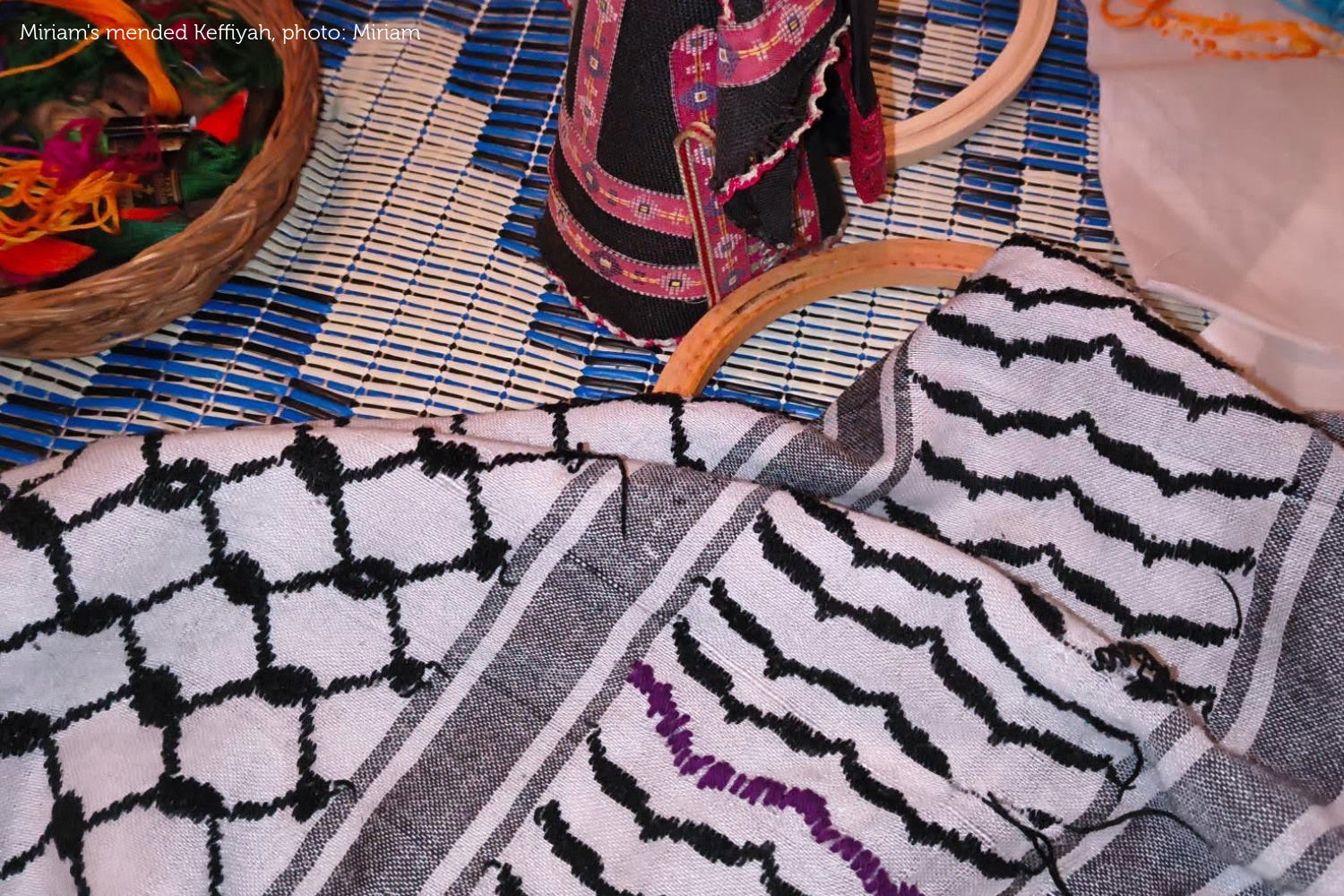
“The kantha connections circles reminded me how difference can be a beautiful connector in itself when people want to share and to support each other. [It offered] a curious and generous mindset that allowed for beautiful exchanges with people I never met before, calmly weaving together topics around stitching, tradition, respect, fears, and organising in our different contexts.” — Miriam, Germany
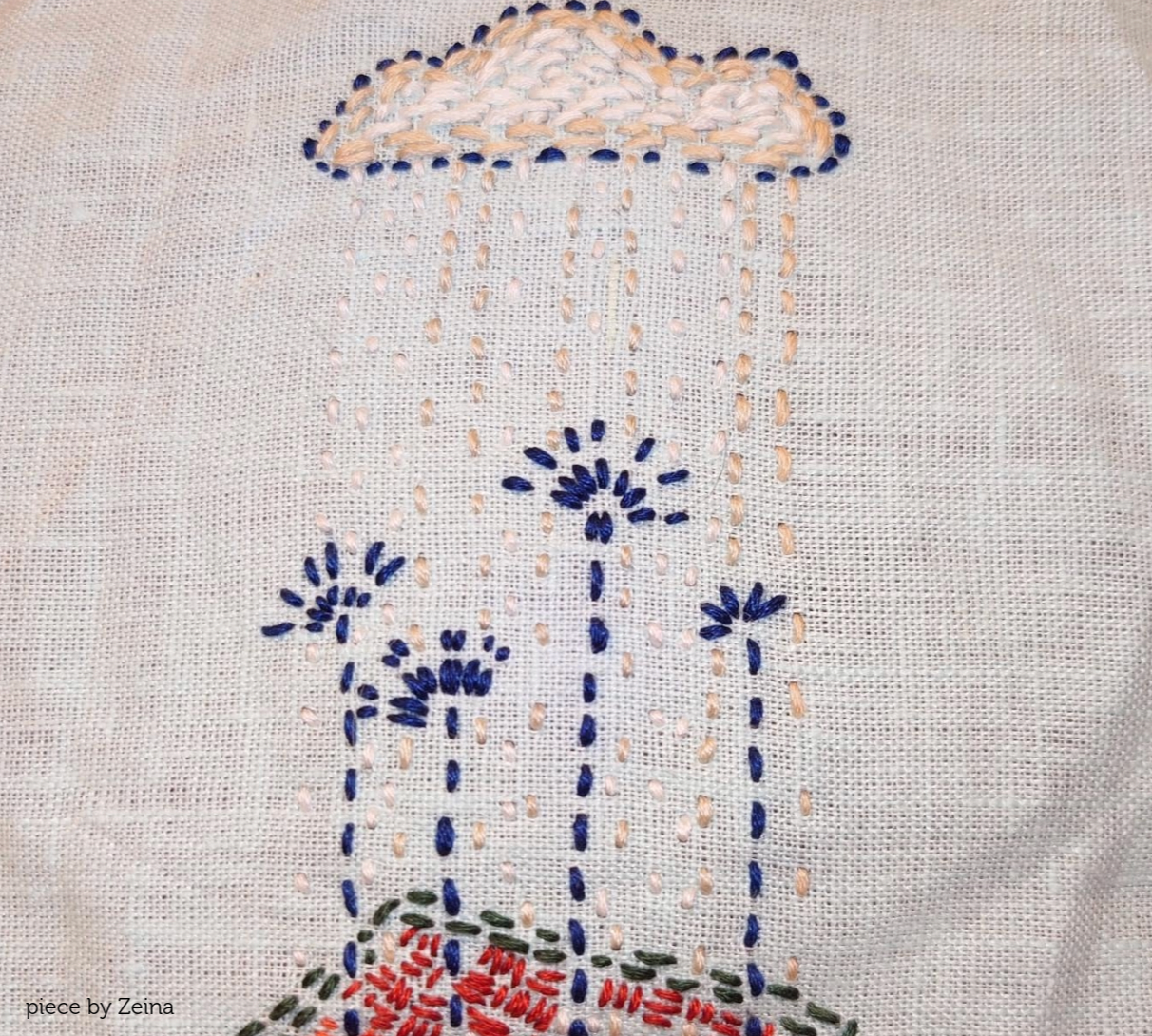
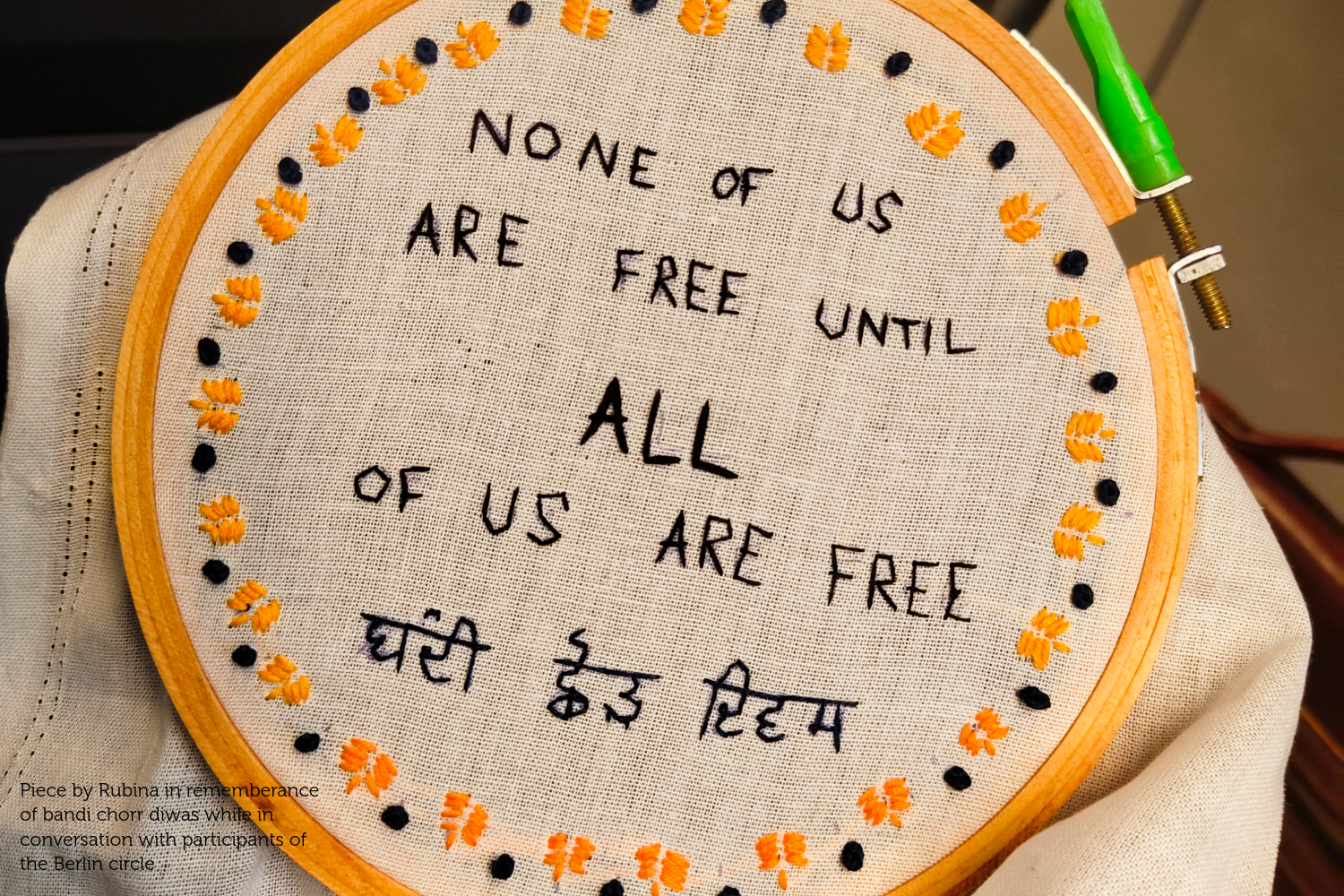
Zeina’s piece came out of our conversation about Bandi Chhor Diwas (Prisoner Release Day) as the Berlin circle happened to fall on this day. This marked a day when a Sikh Guru refused to leave prison unless his fellow Hindu political prisoners were freed alongside him. As we talked about the connections between our resistance struggles in Palestine, Jordan, Germany, and India, Bandi Chhor Diwas offered us a metaphor to imagine new blooms of shared resistance.
Weave
Solidarity is not sameness. These circles have never been about bringing together people who already agree. They are about what becomes possible when difference is the starting point and when the question is not ‘how are we similar’ but ‘what can we make together’.
At PACT Zollverein in Germany, artists from different countries and practices gathered to reflect on interconnection in a room shaped by Germany’s industrial history and its present reckonings. One of the participants , Orakle Ngoy from the Democratic Republic of Congo, spoke of unity in diversity, with the different colours representing different ideas coming together.
“The stitching circle offered a space for people with similar questions on their hearts to meet. It reminded me that many of us are walking parallel paths and that we’re just an arm’s reach from one another. It affirmed to me that meaningful connections can be rooted in fighting for our communities together.” – Cat Lau, a participant from Bangkok
Kushal reflects on what it takes to design a space where genuine encounter is possible across lines of movement, culture, and experience.
“To apply an explicitly social justice lens to the craft of kantha, to ask what does ‘freedom’ mean personally and relationally — that is incredibly powerful. To design and hold these reflective artistic processes requires an astute understanding of time, space and people.” – Kushal Sohal, India / UK
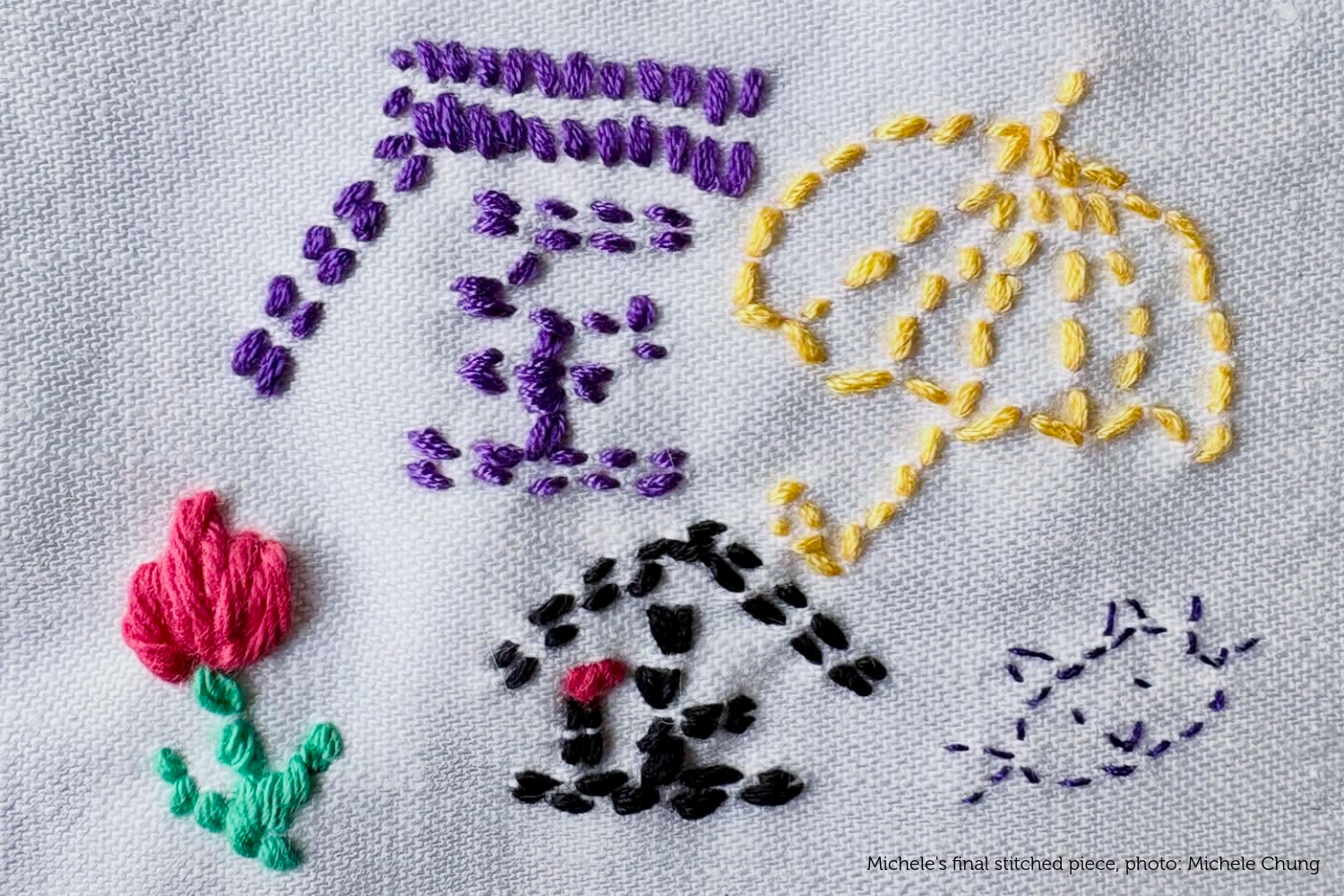
And sometimes, solidarity takes the simplest stitched form like this piece by Michele Chung with the cantonese word for ‘home’, a yellow umbrella as a symbol for Hongkong’s resistance movement, along with a tulip for Iran, and a cat.
Kantha doesn’t hide its stitches. The stitch is visible on both sides of the cloth. These circles don’t resolve the distances between our movements but they make the connections visible: between a solidarity organiser in Berlin, an embroiderer carrying resistance from Iran, an activist reclaiming the street in Kochi, a community recovering textile memory in Kenya.
And something else happens that I didn’t quite anticipate when I started: people leave having found each other. Not just in the political sense of solidarity, but in the simpler, older sense of friendship. They stay in touch,they share what they are making, they check in when the news from each other’s countries gets heavy.
As Raven Frias, a Philipina youth leader who joined the Paris Circle, puts it, “Came for the sewing, stayed for the connection.”
Kantha Connections has been hosted in partnership with Skaped (London), Provisions Kenya (Nairobi), PACT Zollverein and reSource Berlin (Germany), Kerala Museum (Kochi), Bangkok 1899 and Tikkiwallah (Bangkok), and Serve the City (Paris). Circles continue wherever the work travels.
![In rage and solidarity with women putting their lives, bodies, and energies into the fight for safer, more caring futures.
We’re thrilled to introduce three seed grants in support of the rage driven good work by cis and trans women and non-binary people. And we’re even more thrilled to be collaborating with the @schoolofio School to expand the depth and scope of this work.
Application link and details on writingwomen.co
“[it is] our power to envision and to reconstruct, anger by painful anger, stone upon heavy stone, a future of pollinating difference and the earth to support our choices” -Audre Lorde
.
.
.
.
.
#writingwomen #seedgrants #insolidarity](https://writingwomen.co/wp-content/plugins/instagram-feed/img/placeholder.png)