
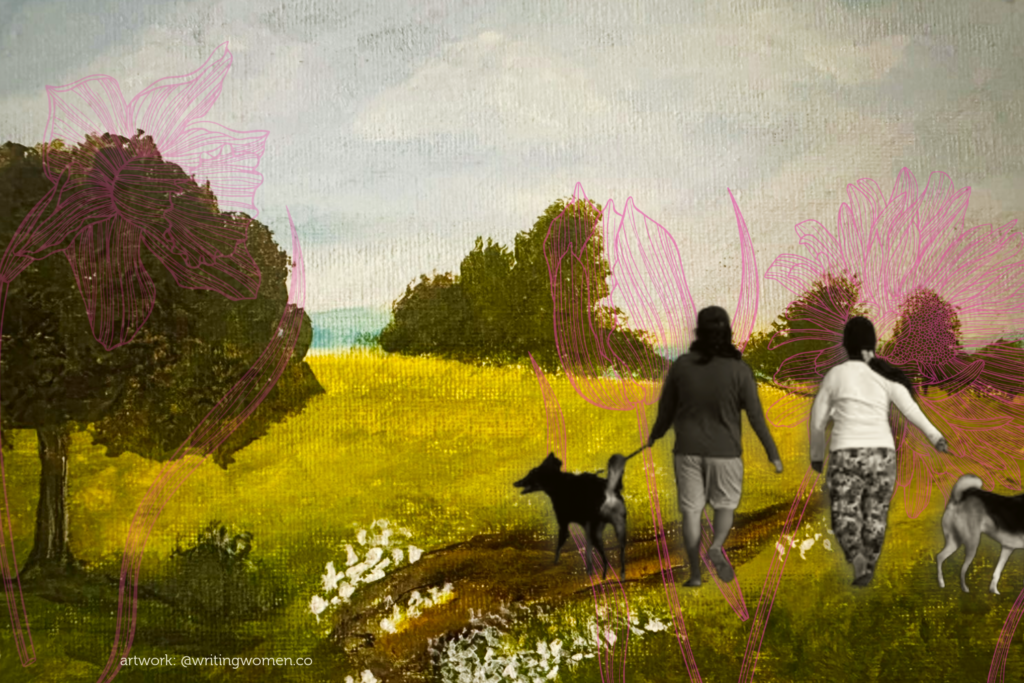
When asked how she made friends in the city, Dorai*, a domestic worker from the Philippines, explained that she was often approached in the mall on her days off by other Filipino women in Dubai who would ask, “Kabayan?” – a Tagalog phrase that roughly translates to “[Are you a] fellow Filipino?” “Oo” signaled yes, and many friendships began from there.
For the longest time, I had seen the structural landscape of the Gulf through the eyes of exploitation and grief. Living in a city that reflects global systems of inequity, it felt impossible not to see sadness in classed isolation, the precarity of migrant life, or in the exhausting conditions of labour under which many were expected to work. Yet in seeing only suffering, I had reduced the lives of migrant workers into one-dimensional narratives of victimhood, refusing to see the ways in which they experienced love, friendship, and meaning.
Our neoliberal world order survives on the underpaid and undervalued labour of women, particularly migrant domestic workers, whose labour and bodies are deemed expendable under a capitalist system. Over 75.6 million people (the majority of whom are women and migrants) are employed in domestic work globally. In the Gulf, women from countries in Southeast and South Asia, and East Africa migrate for such work in middle-class households. Under the region’s kafala sponsorship system, their legal residency is tied to their employer, producing a distinct system of dependency. Despite this structural vulnerability, women still move in the hope of building a better material life for themselves and their families back home.
Across geographies marked by displacement, surveillance, and structural constraint, people resist by refusing to abandon love and care. I am deeply interested in how migrant women navigate intimacy and connection in opposition to systemic isolation—how they forge pockets of joy and community and how we might learn to grow in love together.
In recent years, scholarship has explored how migrant women challenge the precarity of their environments through forming “counterpublics” in their engagement with public spaces. Malls, churches, parks, and restaurants, become sites of sociability and relative freedom from employer households. While this work has, importantly, foregrounded public spaces as weekend sites of gathering and relative autonomy, I found myself wondering how women became friends in the first place, and where moments of intimacy and warmth could emerge even in everyday work life.
My curiosity takes shape through conversations with women in parks and public spaces.
Over the past few months, I have chatted with many as they walk the dogs of the families they work for. While their experiences are far from monolithic, they seemed to find community both within and beyond their role as domestic workers. Miles away from family and friends back home, many women were able to counter isolating conditions by reshaping the demands of their labour into spaces of sharing and receiving love with the dependents they were responsible for caring for. Wenda, a domestic worker who had recently moved from Zimbabwe, shared the intimacies woven into caring for Jackie, the cocker spaniel she feeds, bathes, and walks every morning and evening. She expressed how much she loved Jackie, who often sleeps in her room, and showed me pictures of the two of them together. She then recalled her own dog back in Zimbabwe, Coco — coincidentally of the same breed — whom she missed deeply; in Coco’s absence, Jackie became a source of love and companionship.
Wenda’s experience of finding love and friendship through her relationship with the household pet was not unique; Shantel, a domestic worker who moved from Sri Lanka almost two decades ago, similarly spoke of her closeness with Havier, the dog she looks after. When I mentioned that I loved dogs but did not have one, she expressed great sympathy, repeating “Aw, sorry, darling,” while hugging me multiple times. Her warm response underscored the depth of her attachment to Havier, whom she saw, as her own pet. Listening to Wenda and Shantel, I think of how love grows even in spaces of precarity. Is keeping one’s heart open to love its own kind of resistance?
Relationships formed with the animals in their care were only one of many ways women negotiated seclusion. Using the blurred separation between their work and personal life to their advantage, most women I spoke with called their children every evening while cooking, cleaning, and during their walks with the household dog. They also actively sought out and made friends with other workers in the neighborhood during their shifts. Dog-walking thus became an opportunity to break free from the loneliness of working in their employer’s household and to converse with other domestic workers; I often saw women sitting together, each with her respective dog, chatting on the pavement. After their shifts, gatherings outside a house in the neighborhood to catch up with one another was a common social event.
Friendships often developed in communal spaces, such as religious institutions, as Nehanda, a domestic worker who migrated from Zimbabwe several years ago, made friends with other Zimbabwean women by attending Sunday services at her Pentecostal church. Wenda met fellow Zimbabwean women at her Seventh-day Adventist church. Both described forming friend groups with other churchgoers and making trips to the mall after service to eat, shop, and watch movies together.
Everyday public spaces offered opportunities for women to form friendships. When asked how she made friends in the city, Dorai, a domestic worker from the Philippines, explained that she was often approached in the mall on her days off by other Filipino women in Dubai who would ask, “Kabayan?” – a Tagalog phrase that roughly translates to “[Are you a] fellow Filipino?” “Oo” signaled yes, and many friendships began from there. Interestingly, she also noted that the phrase has since been taken up by migrants of other nationalities in the Gulf, with many South and Southeast Asians using “Kabayan?” as a convenient and friendly way of identifying shared origin; those addressed would often respond in their own native language if they were from the same place.
These relationships, whether formed informally or within more structured communal settings, provided migrant women with networks of support and connection in the face of material challenges and structural vulnerability. Dorai described how she and her friends creatively spent time together by turning everyday movement into an activity itself, walking long distances across the city for fun, enjoying the Metro, and on one occasion riding an entire line from start to end without getting off, simply to admire the view of the city from above. She remembered a birthday celebration in which ten of her friends squeezed into a friend’s bedroom and held a potluck, with each contributing a different dish they had cooked. Resistance meant creating spaces of sharing, challenging our consumption-driven culture that pushes the idea that joy must be paid for.
Through forming bonds in and outside familial spaces, adapting to the informalities of their work, and crafting distinct ways of engaging with the city, migrant domestic workers turned structural isolation on its head through their openness to love and to each other. In reflecting on how people keep their hearts open even under incredible oppression, I am reminded of Ahmed in Gaza, who, under the name the little farmer, continues to plant seeds, tend his garden, and name every cat around him, even amidst the ongoing genocide. For against every system and structure runs the human heart, which remains forever untouchable and free.
.
.
.
*In an effort to preserve their anonymity, I use pseudonyms for the women I spoke to and refrain from sharing any identifiable details.
![In rage and solidarity with women putting their lives, bodies, and energies into the fight for safer, more caring futures.
We’re thrilled to introduce three seed grants in support of the rage driven good work by cis and trans women and non-binary people. And we’re even more thrilled to be collaborating with the @schoolofio School to expand the depth and scope of this work.
Application link and details on writingwomen.co
“[it is] our power to envision and to reconstruct, anger by painful anger, stone upon heavy stone, a future of pollinating difference and the earth to support our choices” -Audre Lorde
.
.
.
.
.
#writingwomen #seedgrants #insolidarity](https://writingwomen.co/wp-content/plugins/instagram-feed/img/placeholder.png)