
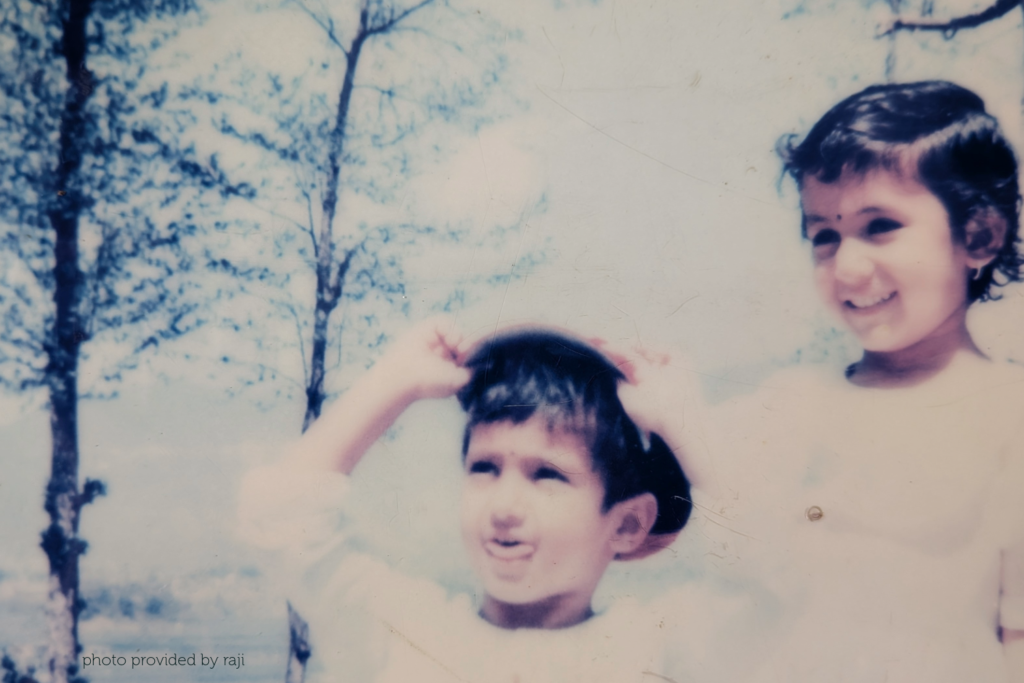
It’s all constructs
Some constructs allow for
A greater freedom than others,
Better well being
Than others,
They create identities that
Allow for optimal well being
-bell hooks
Words provide us with safety. In 2019 discovering the book ‘The Crafting of Grief Constructing Aesthetic Responses to Loss’, gave me space to be with the loss of my brother. And as the book arrived to me, it was as if I had been waiting for it. In the spirit of manifesting the book I had already begun to embrace an aesthetic that dignified my grief for me and vice versa. I made a post on instagram related to the experience, alongside this art:
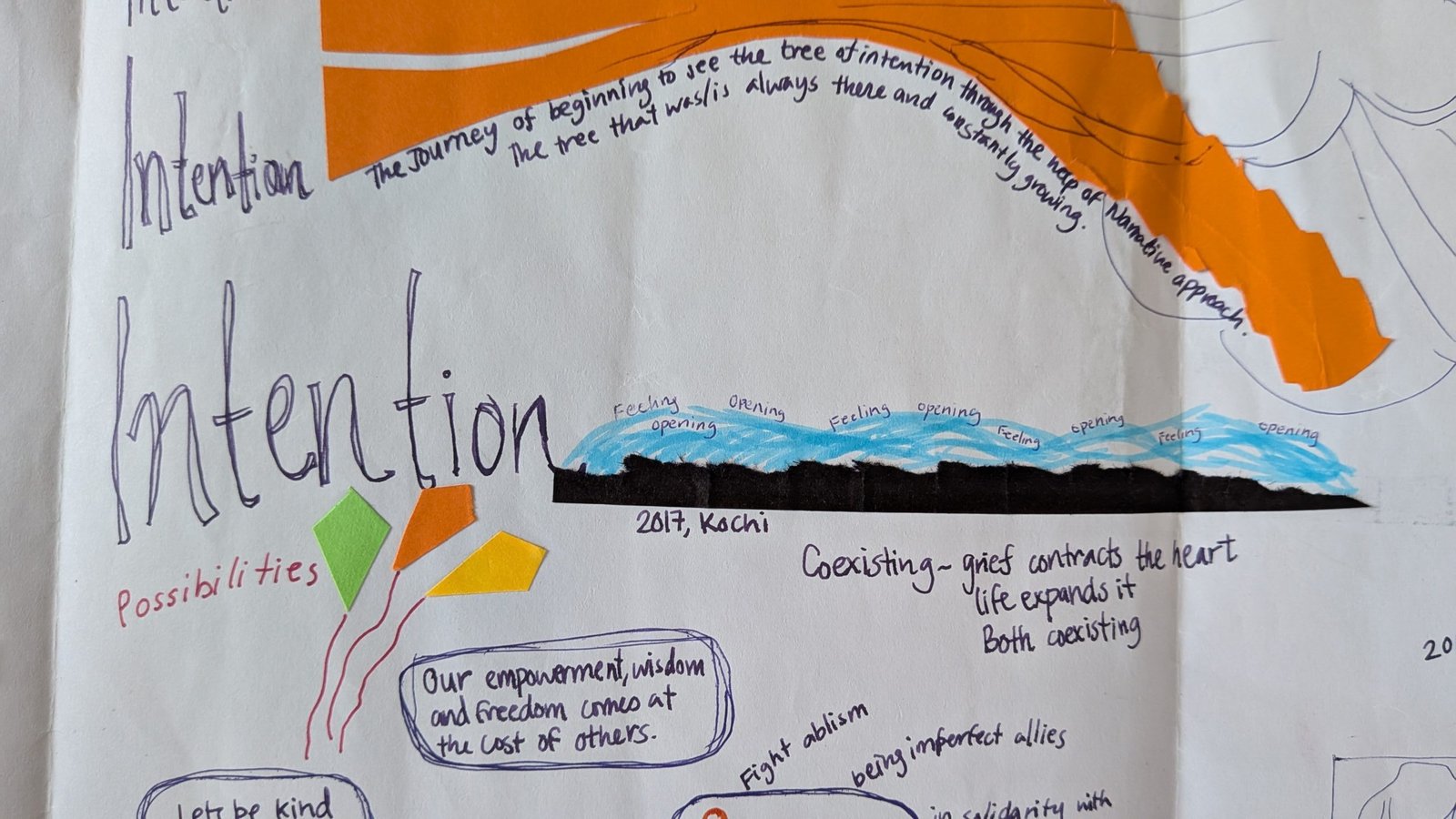
Underneath the post the text read: ‘Last week in Mumbai I was drawing my feelings about grief I had sort of summarized in Kochi in Feb 2017, sitting by the water. For the first time in my life I felt that I didn’t have to choose one, life or grieving. And it was such a relief. I think it was the salty water smell in the air and being on my own and writing, all coming together! #loitering’
I posted this in September of 2018 while doing my narrative practices training in Mumbai. This was the first trip on which I had gone alone and my mother couldn’t sleep for days. My brother, aastik, had died in an accident back in 2011 whilst travelling on his own.
Nothing made sense after that.
The last time I would hug my brother was September 12th, 2010. I am living a reality I never thought I would be alive in, I would repeat to myself. Finally in 2021, I stopped drinking, again another September.
My mother noticed my relationship with alcohol and alerted me. It was definitely not easy. Because it was helping me numb the pain of seeing her and baba’s face, meeting their gaze and seeing my brother’s face reflected back at me. It still kills me to imagine what my mother feels, looking at her own hands that held my brother when he was a baby. She often looks at my long limbs and says “ all of these used to fit on my lap.” I collapse into a puddle of tears. We hold each other. There is a salwar kameez set that is still upstairs with me, the last thing my brother chose for her. This year something has shifted, and she said maybe soon when i say it would look lovely on her. Numbing is necessary, until there is a knowing that maybe you don’t need it;, and as I look back at my drinking I am grateful for my instinct to want to stay alive. Embracing this contradiction helped me hold myself accountable to feel the scary feelings and be in discomfort, and with that also came the solace that I wasn’t alone.
After I moved back home I was carrying this rage of how dare he leave me alone. My parents’ sadness was all about how he had so much to explore and live for. They were so unselfish in their confrontation of this grief. They created this space that has allowed me to stay sober everyday. And so walking alongside grief, now i do not feel so alone.
I am living a reality I never thought I would be alive in, so might as well live a life worthy of all the love I receive, I was able to add, as a skeptic who feels at times that living is over rated. And through this sentiment, sharing it, moving through it, finding out how cliche and important it is to indeed live one day at a time.
And then came September 2025.
I was in a nearby forest park with friends trying to make sense of the growing student movement when we were alerted to the news of the death of young kids on our phones. It steadily rose.
We huddled in my house, which was closest, to avoid the main roads. It wasn’t safe for either of my friends, who were Gen Z. It felt to me like every young person had a mark on their backs. It was unlawful to be young, the state had decreed through its actions.
Young people protested the blanket social media ban by the government. They went confidently in school uniforms because the consensus was that as students in uniform, they would be protected from any violence. The youngest of the students who were shot dead was 17. The youngest of the students shot dead was 17. Complete chaos had taken over the protest and the head of the police gave orders to protect “your own” to his police squad. Protect your own? Later it was revealed that shootings had started taking place.
The second day was even more violent and there was a vigil in my chowk. There were around 10 or 12 of us from our neighborhood, head down staring at the candles and the pictures of the kids who are permanently gone. My parents and I were thinking of all the mothers who had heard the news of losing their child. These thoughts create a certain kind of hardening of my chest muscles, and an icy feeling, in nepali chisoo pasyo…it’s a dread I cannot explain.
A shiver and a sound like a wounded animal resonates and I look to my left, a woman her body shaking starts crying and making noises that don’t need interpretation. Her face scrunched up and pulsating under the candle light. It is grief reincarnated. Deuta chadheko, she is possessed, seemed to be the consensus in everyone’s eyes. No one said anything. Her body came to a stop. The gathering began to disperse.
I walk back through the main gate of my home, and two steps in, a big cry comes out from deep within me. I feel so sad and so enraged. I ran into her the very next day at the neighborhood shop and thanked her for helping me get that cry out of my body.
‘These are martyrs, they have freed us’, I hear this over and over from many mouths, and mouth pieces on TV.
We hear the word martyr on a daily basis from the horrible ongoing genocide in Palestine along with the heart felt narratives that give these deaths dignity. From what I understand, being connected to one’s identity and belonging, or standing up for a place, or knowing what we are defending is something that can happen at an early age. Children understand this. And I struggle to type this because we shouldn’t be living in such a world.
But misusing that narrative and imposing martyrdom on young people’s murder, that enrages me.
The murderous hegemonic machinery of nation states imitate each other and justify each other’s actions. The murder of young people on September 8th, was just that. In the name of national security they murdered without hesitation because they have seen that nothing will be done.
These were young people who were just beginning to understand their sense of self. Many of whom were worried about their future, and looking outwards to make ends meet. A nation state that creates such imposition on young bodies is not deserving of their loyalty. Period.
My brother’s death was an accident. It humbled us because we aren’t special. Also grief is always there when we choose to love because loss is inevitable. My parents and I repeat this to ourselves all the time.
But.
These kids didn’t go there to give their life for the sake of the nation. They went for a peaceful protest. And many of them did not come home. My parents and I worried about the hearts of the family. What really enraged me was that I could relate to parents using the construct of martyrdom to make senseless deaths feel dignified. But when the nation, the media and people in general use that word to justify horrible deaths, that really fucked with my head.
Martyrdom has become a category through which the state forces the family to be complicit in the state’s agenda, to see the state as a bystander rather than a culprit. The families are given money for accepting this label and forever stuck in this mold of grief–a mold imposed and cemented in history books. It reminded me of people who have told me to stop crying, get married and have babies so I don’t wallow in that grief. Whatever the root of loss, this is a universal narrative thrown at us grievers to change so that we can make everyone else comfortable.
How dare they?
When death is a more private affair those are the dominant narratives. And when death is not accidental, or is a larger result of a political system, the dominant discourse is gaslighting us to think of these murders as the making of martyrs.
And for what? To preserve nationalism, something that as we look around, only harms young bodies. The dis-ease that is nationalism takes and takes, until the body is so numbed out and docile.
To tell these mothers that they should be proud—how dare they?
It was the 25th year anniversary of the film Rang de Basanti and there were posts on instagram about how these kinds of movies won’t be made again. Trying to find a good enough depiction of what martyrdom may look like in our times, I feel the movie really captures intentionality directed towards a mass audience– a call to action. For Nepali youth that day in September 2025, what happened was far from that.
My brother’s loss is held by my parents, me, our home, friends to whom I have expressed the debilitating nature of rage, and asked them to share it with me because otherwise it will swallow me whole. That to me has paved a way from always surviving to having access to my senses to taste, smell and feel. This cannot be done alone.
Now these young people’s violent deaths at the hands of the state, the known and many many unknown, the term martyr is being used to numb us to submission.
This narrative that tells us to ‘move on’ is so lethal, and is used under the guise of nation building. For nepalis, the reality is that due to lack of modes of earning majority of young folks go abroad to work. This has meant that even before and more visible since October 7th is this morbid phenomenon of at least one Nepali dying in every major conflict in the world, be it Ukraine, Russia the occupied Palestinian territory.
Move on? To where?
There is no moving on. We have to sit with this discomfort. There is no solace here. Nothing to numb the pain. The pain that the nation state is so afraid that we feel, and pushes numbing agents towards us–we have to feel it, take our time and more importantly never do it alone. Every moment I think of the parents who wake up and realize the devastation—there is no looking away.
It’s like staring at the night sky and finding these faded away stars still pulsating, our grief holding us together. It calls to us and says do not look away. Do not rush. What we haven’t spent time grieving, we cannot know.
I leave you with some questions that you may have already felt in your body, and anytime you feel alone, remember I am there:
Can we share this grief and rage, so it doesn’t burden the few?
What would it look like if we chose not to look for instant comforts, in the body, in our language?
How then would we use language to think about our younger selves and young individuals around us?
What if we know this wound will never heal, and we continue to live alongside it?
Borrowing from the wisdom of audre lorde: For what do you not have words yet?
.
.
.
.
.
photo provided by raji